
Super Select 4WD is Mitsubishi’s proprietary transfer case system that sets the Pajero apart from every other 4×4 in its class. Unlike conventional part-time systems that force a choice between tarmac comfort and off-road capability, Super Select lets you switch between two-wheel drive and full-time four-wheel drive at speeds up to 100 km/h, no stopping, no clutching, no drama. This guide covers every mode, when to use it, and the mistakes that damage drivetrains.
What Is Super Select 4WD?


Super Select 4WD (commonly abbreviated SS4) is a full-time-capable transfer case system first introduced by Mitsubishi on the second-generation Pajero in 1991. It was a landmark in Japanese four-wheel drive engineering, the first system on a Japanese 4×4 to combine part-time 4WD, full-time 4WD, and low-range capability in a single selector.
The key innovation is the viscous coupling centre differential, which allows the front and rear axles to rotate at slightly different speeds when in 4H (four-wheel drive high), eliminating the drivetrain wind-up that plagues locked part-time systems on tarmac. You can drive in 4H indefinitely on any surface, wet or dry. When you need maximum traction, you lock the centre differential for a true 50/50 torque split between front and rear axles.
Super Select II (SS4-II), introduced on the third-generation Pajero (1999–2006) and carried through to the fourth generation and the Pajero Sport, refines the original system with electronic terrain modes (Gravel, Mud/Snow, Sand, and Rock on later models) and improved low-range engagement.
Super Select 4WD Modes: The Four Settings Explained
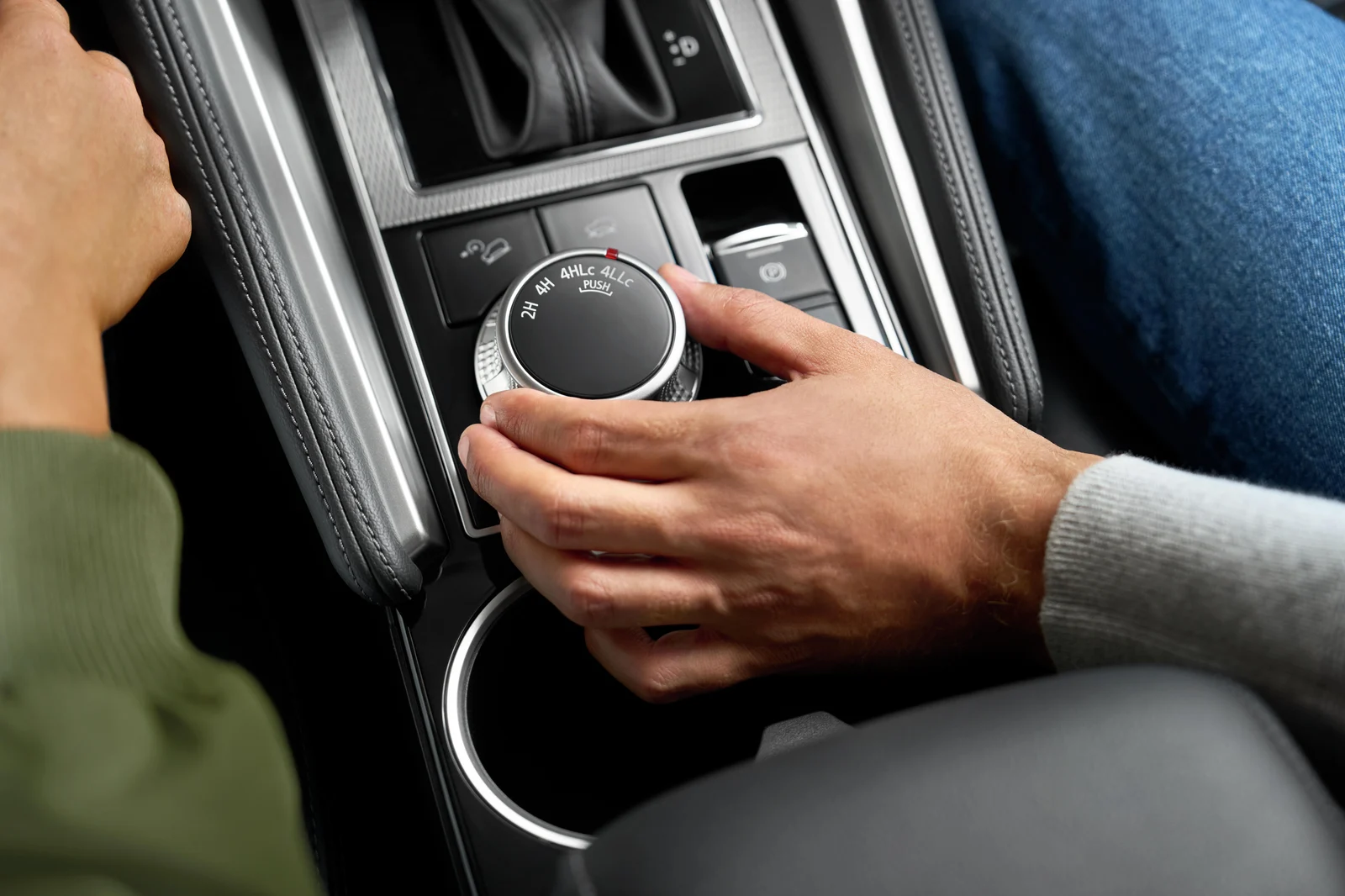
Here is what each dial position does to the drivetrain. In 2H drive goes to the rear axle only (the front wheels are disconnected), the most efficient setting for tar. Turn to 4H and the front axle is engaged too, so all four wheels drive through an open centre differential that still lets the front and rear rotate at slightly different speeds, which is what makes 4H safe to use on grippy, high-traction surfaces. Push and turn to 4HLc (or 4LLc for low range) and the centre differential locks, fixing a 50/50 front-to-rear torque split for maximum traction in mud, sand and steep off-road going.

Rear-wheel drive

Full-time 4WD
(open centre diff)

Centre diff locked
(50/50 split)
The Super Select dial or selector offers four positions. Each has a specific purpose. Using the wrong mode, particularly 4HLc on dry tarmac, can cause significant drivetrain stress. Here is exactly what each mode does and when to engage it.
| Mode | Full Name | Drive Type | Centre Diff | Best Used On | Max Speed |
|---|---|---|---|---|---|
| 2H | 2WD High Range | Rear-wheel drive only | Disengaged | Dry tarmac, highway | No limit |
| 4H | 4WD High Range | Full-time 4WD | Open (viscous coupling) | Wet tar, gravel, light dirt, highway safety | No limit |
| 4HLc | 4WD High Range, Centre Diff Locked | Full-time 4WD, locked | Locked: 50/50 front/rear | Mud, sand, slippery surfaces, loose terrain | 80 km/h |
| 4LLc | 4WD Low Range, Centre Diff Locked | Low-range 4WD, locked | Locked: 50/50 front/rear | Rock crawling, steep climbs, deep mud, river crossings | 30–40 km/h |
2H: Two-Wheel Drive High Range
2H is standard rear-wheel drive. The Pajero’s default mode for everyday commuting and long highway runs on dry sealed surfaces. With the front axle disengaged, the drivetrain runs with the least friction and highest fuel efficiency.
When to Use 2H
- Dry tarmac roads and freeways
- Any surface where traction is not a concern
- Long highway stretches to maximise fuel economy
- Urban driving on dry roads
Switching from 2H to 4H
On Super Select, you can switch from 2H to 4H at any speed up to 100 km/h. Simply rotate the transfer case selector or dial, no stopping required. This is the defining advantage of Super Select over conventional part-time systems, which require the vehicle to be stationary or moving very slowly to engage 4WD.
4H: Four-Wheel Drive High Range (Open Centre Diff)
4H is full-time four-wheel drive with an open centre differential, meaning power is distributed between the front and rear axles through the viscous coupling, but the diff is free to allow slight speed differences between axles. This eliminates transmission wind-up, so you can use 4H on tarmac without stressing the drivetrain.
When to Use 4H
- Wet or damp tarmac where added traction improves safety
- Gravel and dirt roads at highway speeds
- Mixed-surface driving: you encounter some gravel, some tar
- Early morning game drives on firm dirt tracks
- Any time you want improved stability without locking differentials
- Light sand or loose surfaces that do not require full lock
A common misunderstanding among Pajero owners is that 4H “wastes fuel” compared to 2H. The increase in fuel consumption when driving 4H versus 2H on tarmac is modest, typically 1 to 2 litres per 100 km. For the safety benefit on wet roads, particularly at highway speeds in South African summer rainstorms, this is a worthwhile trade. Mitsubishi engineers designed 4H for exactly this continuous mixed-use scenario.
4HLc: Four-Wheel Drive High Range, Centre Diff Locked
4HLc locks the centre differential, forcing a fixed 50/50 torque split between the front and rear axles. This is your workhorse off-road mode. Used whenever wheel spin is a real risk and you need maximum traction at speed. With the centre diff locked, there is no slip between front and rear; if one axle loses traction, the other still drives the vehicle forward.
When to Use 4HLc
- Muddy tracks where wheel spin is likely
- Soft sand at moderate speed (beach driving, dune approaches)
- Wet, slippery clay or black cotton soil
- Snow or ice on a tar or gravel road
- Loose rocky surfaces where tyre slip could occur
- River crossings at low depth where you can maintain speed
Critical Warning: Do Not Use 4HLc on Dry Tarmac
This is the most important rule of Super Select operation. When the centre differential is locked and you drive on a high-traction surface like dry tarmac, the front and rear axles cannot rotate at different speeds through corners. The drivetrain absorbs this stress as transmission wind-up, progressive torque build-up in the propshaft and transfer case components. On short distances this causes handling bind and jerking. Over time, or at speed, it causes premature wear to the transfer case, propshafts, and differential internals. Always return to 4H or 2H when you return to tarmac.
How to Engage 4HLc
- Slow to below 80 km/h.
- Rotate the transfer case selector or dial from 4H to 4HLc.
- A confirmation indicator light will illuminate on the dashboard.
- If the light flashes and does not hold, roll the vehicle forward or backward slightly while the selector is held in position. The splines will align and lock.
4LLc: Four-Wheel Drive Low Range, Centre Diff Locked
4LLc is maximum-traction, maximum-torque mode. Low range multiplies the engine’s torque through a secondary gear reduction in the transfer case, dramatically increasing pulling and crawling power at very low speeds. The centre differential is locked throughout. This is the mode for the most demanding off-road situations, where speed is low, obstacles are severe, and you need every newton-metre the drivetrain can produce.
When to Use 4LLc
- Rock crawling: technical boulder fields, rocky ascents and descents
- Steep hill climbs where low-speed torque control is essential
- Deep mud where momentum alone will not carry the vehicle through
- River crossings deeper than 600 mm (up to the Pajero’s wading depth)
- Recovery situations: self-recovery or winching
- Heavily loaded off-road towing (camp trailer, caravan) on rough terrain
- Steep downhill descents: 4LLc combined with hill descent control (Gen 4) provides engine braking
How to Engage 4LLc
- Bring the vehicle to a complete stop.
- Place the automatic transmission in N (Neutral). Do not skip this step.
- Rotate the transfer case selector from 4H or 4HLc to 4LLc.
- Wait for the low-range indicator light to illuminate and hold steady.
- Select D (Drive) or a specific gear and proceed at low speed.
How to Disengage 4LLc
- Come to a complete stop or roll very slowly.
- Place the automatic transmission in N (Neutral).
- Rotate the transfer case selector back to 4H or 2H.
- Allow the indicator light to confirm the change.
- Select D and resume normal driving. Note: if returning to 2H on tarmac, allow a short distance to let drivetrain stress normalise before high-speed driving.
Super Select I vs Super Select II: What Changed?
Both systems share the same four-mode architecture, but Super Select II (SS4-II), introduced with the third-generation Pajero in 1999, brought three improvements worth knowing about.
| Feature | Super Select (SS4), Gen 2 | Super Select II (SS4-II): Gen 3 / Gen 4 / Pajero Sport |
|---|---|---|
| Modes | 2H / 4H / 4HLc / 4LLc | 2H / 4H / 4HLc / 4LLc + electronic terrain modes |
| Terrain modes | None | Gravel, Mud/Snow, Sand, Rock (4LLc only) |
| Low-range engagement | Mechanical, requires precise stop-and-neutral procedure | Electronically assisted, smoother engagement |
| ABS integration | Basic multi-mode ABS | Terrain-specific ABS calibration per mode |
| Vehicles | Pajero Gen 2 (V20/V30), 1991–1999 | Pajero Gen 3 (V60/V70), Gen 4 (V80/V90), Pajero Sport |
Electronic Terrain Modes (Super Select II, Gen 3 and Later)
From the third-generation Pajero onwards, Super Select II added a separate terrain mode selector that works in conjunction with the 4WD position. These modes adjust the engine throttle map, transmission shift points, ABS thresholds, and traction control behaviour for specific surfaces. They do not replace the transfer case modes. They refine them.
Gravel Mode
Available in 4H and 4HLc. Recalibrates the ABS to allow brief controlled lockup, improving stopping distances on loose gravel where conventional ABS can pump ineffectively on a sliding surface. The throttle response is slightly softened to reduce initial wheelspin on gravel departure. Recommended for any unsealed road at speed.
Mud/Snow Mode
Available in 4HLc and 4LLc. Delays ABS intervention slightly to allow the tyres to build a wedge of mud or snow in front of the wheel during hard braking, improving deceleration on these surfaces. Throttle management reduces initial wheelspin on departure. Use in 4HLc for muddy tracks and snowy passes, or in 4LLc for deep mud recovery.
Sand Mode
Available in 4HLc and 4LLc. Permits a controlled level of wheelspin, the opposite of traction control’s instinct to cut power. On soft sand, a degree of wheelspin keeps the tyres floating on top of the surface rather than digging in. The transmission holds lower gears longer to maintain momentum. Combine with reduced tyre pressure (1.0–1.4 bar for soft sand) for best results.
Rock Mode
Available in 4LLc only. Enables individual wheel control through the ABS/traction control hardware, mimicking electronic locking differentials by braking spinning wheels and transferring torque to those with grip. This is the Pajero’s closest equivalent to a rear diff lock on technical rocky terrain. Combine with slow, controlled throttle inputs and hill descent control for maximum precision.
Quick Mode Selection Reference
| Surface / Situation | Recommended Mode | Terrain Mode | Notes |
|---|---|---|---|
| Dry tarmac highway | 2H | Off | Best economy; no traction concern |
| Wet tarmac / rain | 4H | Off | Improved stability; no diff lock required |
| Gravel road, normal speed | 4H | Gravel | Open centre diff fine on firm gravel |
| Wet gravel / slippery dirt | 4HLc | Gravel | Lock centre diff for traction security |
| Deep mud | 4HLc or 4LLc | Mud/Snow | Use 4LLc if forward progress is failing |
| Soft sand: beach / dune | 4HLc | Sand | Reduce tyre pressure; maintain momentum |
| Deep soft sand / dune climb | 4LLc | Sand | Low range for maximum torque at low speed |
| Snow / ice on tar | 4HLc | Mud/Snow | Locked centre diff and calibrated ABS |
| Rocky track / crawling | 4LLc | Rock | Slowest speed; maximum torque control |
| River crossing | 4LLc | Off or Mud/Snow | Steady speed; do not stop mid-crossing |
| Steep hill descent | 4LLc + HDC | Rock or Off | Hill Descent Control (Gen 4+) manages speed |
| Recovery (self or winch) | 4LLc | Off | Maximum pulling torque at minimal speed |
Common Super Select Mistakes to Avoid
- Using 4HLc on dry tarmac. This is the most damaging error. The locked centre differential creates transmission wind-up on high-traction surfaces. Return to 4H or 2H as soon as you reach tarmac, even a short stretch.
- Trying to engage 4LLc while moving. Low range requires a complete stop and neutral gear. Attempting to engage it while rolling risks damaging the transfer case internals. Stop first, every time.
- Forgetting to disengage low range before highway driving. The maximum comfortable speed in 4LLc is around 30–40 km/h. Driving above this range over-revs the drivetrain and causes significant mechanical stress. Disengage before returning to tarmac or normal speeds.
- Leaving 4H engaged on long dry highway runs unnecessarily. The viscous coupling in 4H is designed for mixed-surface use. While driving 4H on dry tarmac will not cause wind-up (the open centre diff prevents this), the slight additional friction over thousands of kilometres is unnecessary if you are staying on dry tar. Switch to 2H for long highway legs.
- Not allowing indicator lights to confirm mode changes. Always wait for the dashboard indicator to illuminate and hold steady before proceeding. A flashing or absent light means the mode change has not completed, roll the vehicle slightly to help the splines seat.
Super Select 4WD Across Pajero Generations
Not every Pajero is fitted with Super Select. Here is where the system appears across the model range.
| Generation | Years | 4WD System | SS4 Version |
|---|---|---|---|
| Gen 1 (L040) | 1982–1991 | Part-time 4WD, stationary engagement only | No Super Select |
| Gen 2 (V20/V30) | 1991–1999 | Super Select 4WD introduced 1991 | SS4 (original) |
| Pajero Evolution (V55W) | 1997–1999 | Super Select 4WD | SS4 (original) |
| Gen 3 (V60/V70) | 1999–2006 | Super Select II, terrain modes added | SS4-II |
| Gen 4 (V80/V90) | 2006–2021 | Super Select II, Rock mode added, HDC on high spec | SS4-II |
| Pajero Sport (2017–) | 2017–present | Super Select II: 4×4 derivatives only | SS4-II |
| Gen 5 (2026–) | 2026– | Confirmed Super Select II, details pending reveal | SS4-II (expected) |
Note: Some Pajero Sport variants are offered as 4×2 (rear-wheel drive only) in certain markets. Only the 4×4 derivatives of the Pajero Sport carry the Super Select II system. Always confirm the drivetrain specification before purchasing.
Frequently Asked Questions: Super Select 4WD
What does Super Select 4WD mean on a Pajero?
Super Select 4WD is Mitsubishi’s name for the transfer case system in the Pajero that allows the driver to select between rear-wheel drive (2H), full-time four-wheel drive with an open centre differential (4H), locked four-wheel drive high range (4HLc), and locked four-wheel drive low range (4LLc). The “Super Select” designation reflects the ability to switch between 2H and 4H on the move, at speeds up to 100 km/h, a capability not found on conventional part-time 4WD systems.
Can you switch from 2H to 4H while driving?
Yes. This is one of Super Select’s defining advantages. You can switch between 2H and 4H at any speed up to 100 km/h without stopping or reducing speed significantly. Simply rotate the transfer case selector. The system’s viscous coupling centre differential allows this on-the-fly engagement safely.
What is the difference between 4H and 4HLc on the Pajero?
Both are four-wheel drive high range, suitable for off-road driving at normal speeds. The difference is the centre differential. In 4H, the centre differential is open (with a viscous coupling), allowing slight speed differences between the front and rear axles. This is safe on tarmac and light off-road surfaces. In 4HLc, the centre differential is locked, forcing an exact 50/50 torque split between axles. This provides maximum traction on slippery surfaces but causes transmission wind-up on high-traction tarmac, so 4HLc must not be used on dry sealed roads.
When should I use 4LLc on the Pajero?
4LLc (four-wheel drive low range, centre diff locked) is for the most demanding off-road situations: rock crawling, steep climb and descent, deep mud, river crossings, and recovery. The low range reduction multiplies engine torque, giving you precise, powerful traction at very low speeds, typically below 30–40 km/h. To engage 4LLc, you must bring the vehicle to a complete stop, shift the automatic transmission into Neutral, then select 4LLc.
Is it bad to drive in 4H on tarmac?
No: 4H is safe on tarmac. Because the centre differential is open in 4H, there is no transmission wind-up. You can drive in 4H on dry or wet tarmac without mechanical harm. Fuel consumption increases modestly (typically 1–2 L/100 km) compared to 2H. For long, dry highway runs, 2H is the more economical choice. For wet roads or mixed-surface driving, 4H is the recommended setting.
What happens if you use 4HLc on dry road?
Using 4HLc on dry tarmac causes transmission wind-up, a dangerous build-up of torque stress in the transfer case, propshafts, and differentials. On short distances you will notice handling bind and a jerky feeling, particularly through corners. Over time this causes accelerated wear to transfer case internals. Return to 4H or 2H immediately when you return to a sealed road surface.
Does the Pajero Sport have Super Select 4WD?
Yes: the 4×4 derivatives of the Mitsubishi Pajero Sport are fitted with Super Select II (SS4-II), the same system as the Gen 3 and Gen 4 Pajero. The Pajero Sport’s SS4-II includes four transfer case positions (2H / 4H / 4HLc / 4LLc) plus electronic terrain modes: Gravel, Mud/Snow, Sand, and Rock. Note that 4×2 variants of the Pajero Sport are rear-wheel drive only and do not include Super Select.
Which Pajero generation first had Super Select?
Super Select 4WD was introduced on the second-generation Pajero (V20/V30 series) in 1991. It was one of the first systems on any Japanese four-wheel drive vehicle to combine part-time 2WD, full-time 4WD with an open centre differential, and locked 4WD low range in a single selector. The first-generation Pajero (1982–1991) used a conventional part-time system requiring the vehicle to be stationary to engage four-wheel drive.
How many times can I switch between 2H and 4H per trip?
There is no limit to how many times you switch between 2H and 4H during a trip. The on-the-fly engagement up to 100 km/h is a core design feature. The selector dial (Gen 4) or lever (Gen 2/3) is designed for regular use. Switch as many times as surface conditions require. This is precisely what Super Select was built for.
Super Select 4WD: The Bottom Line
Super Select 4WD is what separates the Pajero from the majority of its competitors in one fundamental way: it removes the compromise. You do not have to choose between fuel economy and safety, between comfort and capability. 2H for the highway; 4H for everything in between; 4HLc for the serious stuff; 4LLc for the extreme stuff. That four-position logic has been in production since 1991 and, with minor refinements in SS4-II, remains the benchmark transfer case system for vehicles in this class.
The Dakar Rally record, 12 overall wins, 7 consecutive from 2001 to 2007, is the real-world proof of what this drivetrain architecture can do. In competition-prepared form, the T2-class Pajero was virtually identical to the road car. The Super Select system that won across North Africa and Saudi Arabia is the same system that gets South African Pajero owners home through flooded crossing on the road to Mabalingwe.
Use it correctly, respect the mode boundaries, and Super Select 4WD will serve you for hundreds of thousands of kilometres without complaint.
Related: Pajero Generations Guide · Pajero Sport · SWB vs LWB Comparison · Dakar Rally Legacy