
The Mitsubishi Pajero won the Dakar Rally 12 times between 1985 and 2007, more than any other manufacturer in the history of the event. Seven of those victories came consecutively from 2001 to 2007, a run so dominant it earned Mitsubishi a Guinness World Record. Along the way, the Pajero produced the first Japanese winner in Dakar history, the first woman to win the event outright, and a stage win count of 150 that leaves every rival behind. This is the full record.
The Record at a Glance
| Statistic | Mitsubishi Pajero | Next Best |
|---|---|---|
| Overall Dakar Rally wins (Cars class) | 12 | Peugeot: 8 |
| Consecutive overall wins | 7 (2001–2007) | Peugeot: 4 (1987–1990) |
| Stage wins (1983–2007) | 150 | Peugeot: 78 |
| Factory programme span | 25 years (1983–2007) | – |
| Guinness World Record | Most Dakar Wins, Manufacturer | – |
| First overall win | 1985 | – |
| Final win | 2007 | – |
How It Began: Paris to Dakar, 1983
The Dakar Rally in 1983 was already established as the world’s most demanding overland race, a gruelling crossing of North Africa from Europe, through the Sahara and Sahel, to the Senegalese capital. Mitsubishi entered a four-vehicle factory team using the Pajero, released to the public just the previous year in May 1982. The assumption in the paddock was that the small Japanese manufacturer’s boxy new SUV had no business on a stage alongside seasoned European machinery.
The assumption was wrong. Andrew Cowan and George Debussy brought the Pajero home first and second in the Modified Production class on its debut, and also claimed the team prize. The Dakar was paying attention. The following year, Cowan again placed the Pajero on the podium, third overall. Then in 1985, on only the vehicle’s third attempt at outright victory, Frenchman Patrick Zaniroli drove a Pajero to first place overall, with Cowan second. The headline write-ups named it “King of the Desert.” It was not an exaggeration.
Porsche won in 1986. Peugeot’s turbocharged 205 and 405 then dominated four consecutive years from 1987 to 1990, followed by Citroën in 1991. Mitsubishi was absent from the top step through this period but never absent from the event. The programme deepened, the engineering budget grew, and in 1992 Hubert Auriol, who had already won the Dakar on motorcycles in 1981 and 1983, piloted a Mitsubishi Pajero to the outright win, becoming the first person to win the Dakar on both two wheels and four. The King of the Desert was back.
Complete Pajero Dakar Win Record (1985–2007)
| Year | Driver | Co-driver | Nationality | Vehicle | Historic First |
|---|---|---|---|---|---|
| 1985 | Patrick Zaniroli | – | France | Mitsubishi Pajero | First Pajero overall win. “King of the Desert” earned. |
| 1992 | Hubert Auriol | – | France | Mitsubishi Pajero | First driver to win Dakar on two wheels (1981, 1983) AND four wheels. |
| 1997 | Kenjiro Shinozuka | Hiroshi Gotoh | Japan | Mitsubishi Pajero Evolution | First Japanese driver to win the Dakar. Pajero took top 4 in class. |
| 1998 | Jean-Pierre Fontenay | Gilles Picard | France | Mitsubishi Pajero Evolution | Mitsubishi swept the top 4 overall for the second consecutive year, though the fourth car was Masuoka’s T2 Challenger rather than a Pajero. The team won 15 of the 16 special stages. |
| 2001 | Jutta Kleinschmidt | Andreas Schulz | Germany | Mitsubishi Pajero Evolution | First and only woman to win the Dakar Rally outright. Final Africa-start “classique.” |
| 2002 | Hiroshi Masuoka | Pascal Maimon | Japan | Mitsubishi Pajero Evolution | Mitsubishi swept the top 8 positions in the overall standings. |
| 2003 | Hiroshi Masuoka | Pascal Maimon | Japan | Mitsubishi Pajero Evolution | Back-to-back wins for Masuoka. Start of the unbeaten streak. |
| 2004 | Stéphane Peterhansel | Jean-Paul Cottret | France | Mitsubishi Pajero Evolution | Peterhansel’s first Dakar win on four wheels. Six-time bike winner completes the double. |
| 2005 | Stéphane Peterhansel | Jean-Paul Cottret | France | Mitsubishi Pajero Evolution | Back-to-back for Peterhansel and Cottret. |
| 2006 | Luc Alphand | Régis Monnier | France | Mitsubishi Pajero Evolution | Former World Cup alpine ski champion adds Dakar overall to his CV. |
| 2007 | Stéphane Peterhansel | Jean-Paul Cottret | France | Mitsubishi Pajero Evolution | 7th consecutive Mitsubishi win. Guinness World Record set. Final Dakar win in Africa. |
Note: Mitsubishi accumulated 12 overall wins across the 1985–2007 span. The table above documents all confirmed individual outright winners. The full factory programme ran from 1983 to 2007, 25 years of continuous Dakar participation.
The 2001–2007 Dynasty: Seven Wins, One Record
The seven consecutive wins from 2001 to 2007 are the defining chapter of the Pajero’s motorsport legacy. No manufacturer before or since has strung together a run of that length at the Dakar. Peugeot won four in a row from 1987 to 1990. That was considered remarkable. Mitsubishi doubled it and added three more.
What makes the streak more impressive is the variety of winners it produced. Four different drivers won across those seven years: Jutta Kleinschmidt (2001), Hiroshi Masuoka (2002, 2003), Stéphane Peterhansel (2004, 2005, 2007), and Luc Alphand (2006). This was not one driver carrying a machine to repeated victory. It was a system (the Ralliart preparation, the Pajero Evolution platform, the engineering discipline) that elevated every driver who sat in it.
The 2002 edition stands as the high-water mark of raw dominance. Over the event’s 9,257 kilometres between Arras in northern France and Dakar, Mitsubishi Pajeros occupied the top eight places in the overall standings. Not the top three. Not the top five. The top eight. From first place to eighth, every position was a Pajero. The remaining field was racing for ninth.
The streak ended not because a competitor had caught up, but because the event itself relocated. The 2008 Dakar was cancelled due to security concerns in North Africa. When the rally restarted in South America in 2009, Mitsubishi entered under the Lancer nameplate rather than continuing with the Pajero programme. The 2007 win was the final chapter of the Africa era. It was also the perfect final chapter: Peterhansel and Cottret, who had driven together since their first win in 2004, crossed the line in first. Seven straight. The Guinness record was already set.
Historic Firsts Delivered by the Pajero
Beyond the win count, the Pajero was the vehicle through which several of the Dakar’s most significant milestones were achieved.
1997: The First Japanese Dakar Winner
When Kenjiro Shinozuka crossed the finish line in 1997, he became the first Japanese driver to win the Dakar Rally outright. It was a cultural moment as much as a sporting one, Japan’s most prominent 4×4 manufacturer, racing a road-legal production-based vehicle, winning the world’s most demanding overland event with a Japanese driver behind the wheel. The Pajero that year did not just win the overall classification; it occupied all four of the top positions in the T2 class, completing one of the most comprehensive Dakar performances to that point.
2001: The First Woman to Win the Dakar
Jutta Kleinschmidt’s 2001 victory remains the most historic win in the event’s history. The German driver, competing in a Mitsubishi Pajero Evolution, became the first and still the only woman to win the Dakar Rally outright. The win came in the final “classique” edition. The last time the rally started in Paris and finished in Dakar in the traditional format. Kleinschmidt did not win because the field was weak. She navigated 11,000 kilometres of desert, competed against full factory teams from multiple manufacturers, and crossed the line first on merit. The Pajero that carried her was mechanically identical to those that carried Masuoka and Shinozuka. The vehicle did not change for gender. It won for anyone who drove it well enough.
2004: Stéphane Peterhansel’s First Four-Wheel Win
Stéphane Peterhansel is the most decorated Dakar driver in the history of the event: 14 overall wins across motorcycles and cars. Six of those wins on two wheels came before he switched to cars in 1999. His first victory on four wheels came in 2004 in a Mitsubishi Pajero Evolution, partnered with co-driver Jean-Paul Cottret. It was the first step in a relationship between Peterhansel, Cottret, and the Pajero that would produce three wins in four years and help close out the most dominant manufacturer programme in Dakar history.
The Cars: From Road Pajero to Pajero Evolution
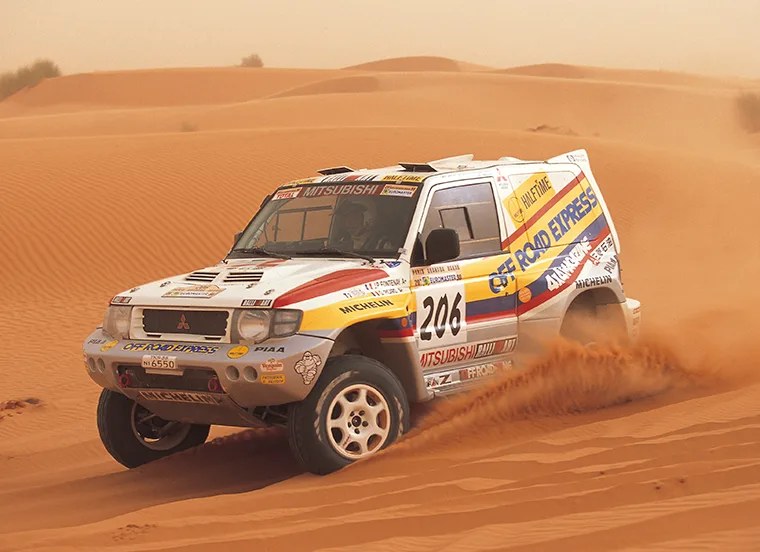
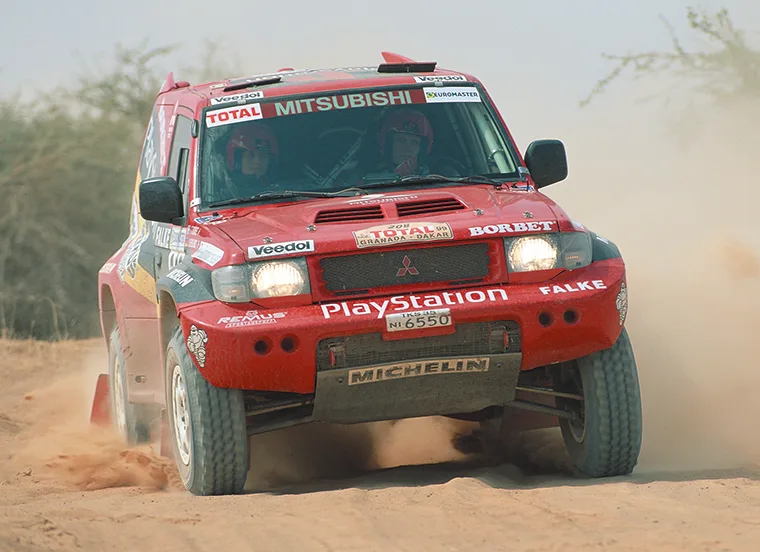
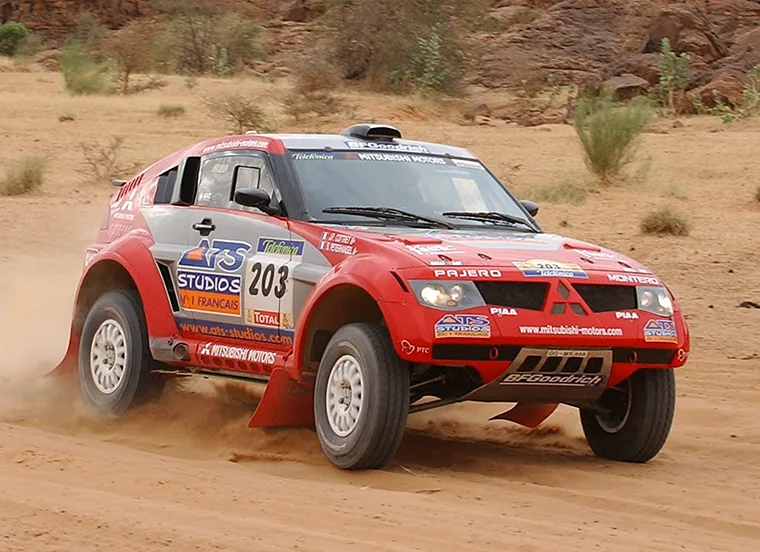
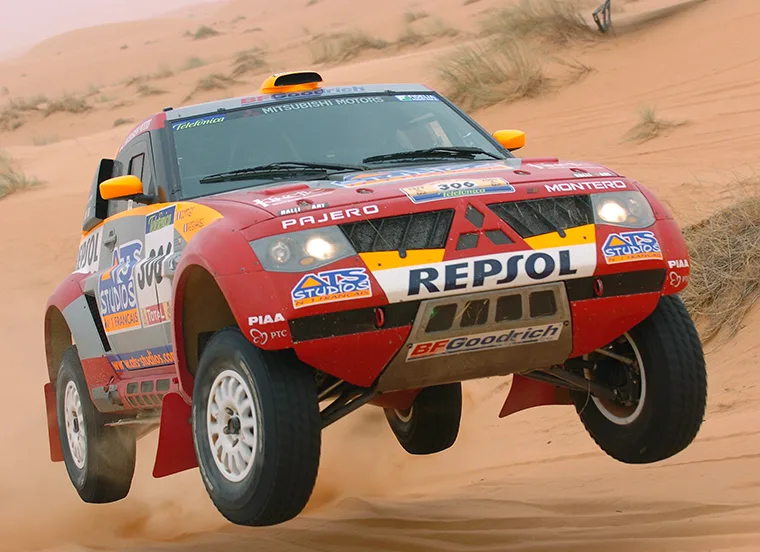
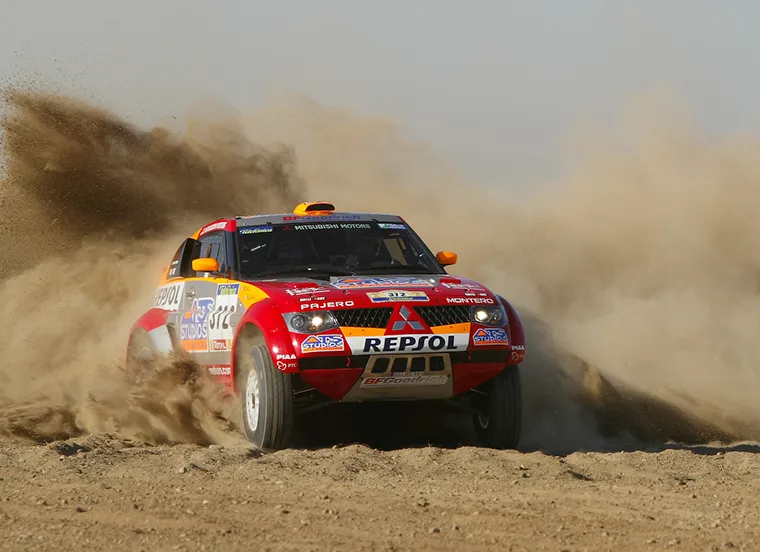
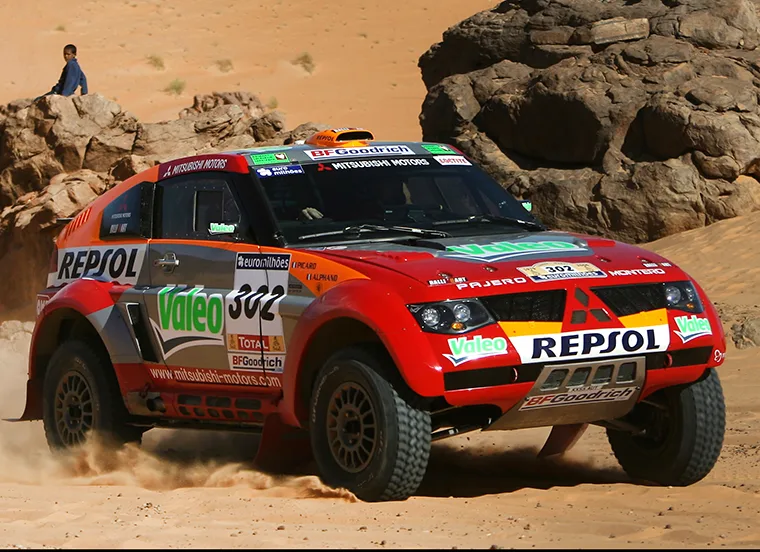
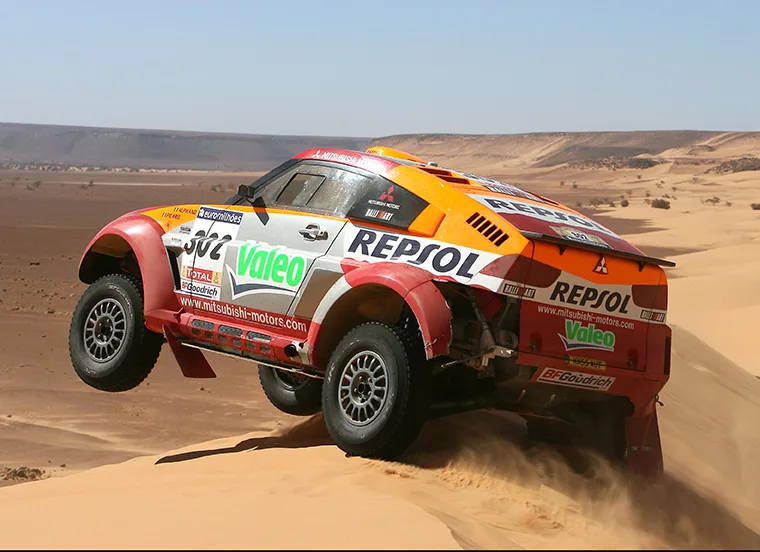
The factory Pajero Evolution Dakar cars, 1998–2009. Images: historic Mitsubishi Ralliart competition programme.
The vehicles that won the Dakar under the Pajero name evolved substantially across 25 years of factory competition, but the connection to the road car was always a defining characteristic, and, in key periods, a regulatory requirement.
1983–1996: Production-Based Competition
In the early years, Mitsubishi competed in the Modified Production class, which required the race vehicles to be recognisably derived from the road car. The modifications allowed were safety-oriented: roll cage, bucket seats, harnesses, navigation equipment, extended fuel tanks. The chassis, engine, and drivetrain were required to remain essentially standard. This meant the Pajero that raced the Sahara was, from an engineering perspective, the same vehicle you could buy from a dealership. The 1985 overall win was achieved in a vehicle that thousands of South Africans were driving to work on Monday morning. That connection between the motorsport record and the road car is a fundamental part of why the Pajero’s Dakar history matters beyond the trophies.
1997–1999: The Pajero Evolution V55W, The Homologation Special
By the mid-1990s, Mitsubishi’s Dakar ambitions had grown beyond what the standard production Pajero could support. To compete in the T2 class with a significantly upgraded platform, the regulations required a minimum production run of road-legal vehicles based on the competition machine. Mitsubishi’s response was the Pajero Evolution, a short-wheelbase, wide-body homologation special built from 1997 to 1999.
Approximately 2,693 units were produced, sold exclusively in the Japanese domestic market. The road car shared the competition vehicle’s widened track (achieved via prominent blister fenders), long-travel independent rear suspension, 3.5-litre 24-valve DOHC V6 engine with MIVEC, and Torsen limited-slip differentials front and rear. It was, in essence, a Dakar car with number plates, one of the most direct translations from motorsport to road car in the history of off-road competition.
The Pajero Evolution produced 1997’s first Japanese Dakar winner, 1998’s top-four sweep, and served as the basis for the competition programme through the entire seven-win streak. Production examples are now rare collectibles; documented cars in good condition command significant premiums in the Japanese and international classic car markets.
2002–2007: The Full Prototype Era
From 2002, new Dakar regulations allowed fully developed prototype vehicles without homologation requirements. Mitsubishi’s response was the MR10 through MR14 series, internal code names for the Pajero Evolution race variants developed exclusively for competition. These vehicles carried engines never intended for road use, including a quad-turbocharged diesel and a 4.0-litre V6 based on an enlarged and modified 6G75 MIVEC block. The body shape retained Pajero identity but the engineering connection to the road car loosened significantly. What did not loosen was the winning. The MR-series vehicles produced five of the seven consecutive victories from 2002 to 2007, driven by Masuoka, Peterhansel, and Alphand.
150 Stage Wins: The Number That Defines Total Dominance
Overall wins tell one part of the story. Stage wins tell a deeper one. Between 1983 and 2007, Mitsubishi Pajero-based vehicles won 150 individual Dakar stages, the fastest time on a specific day’s route. The next-best manufacturer in the same period, Peugeot, won 78 stages. Mitsubishi did not just win more races than everyone else. It was faster, more consistently, across more days, over more terrain, and across more years than anyone who has ever competed at the Dakar. The stage win count is not close. It is not even a competition.
Stage wins reflect reliability as much as outright speed. A manufacturer whose vehicles regularly retire with mechanical failures does not accumulate 150 stage victories. The Pajero programme was engineered with the endurance of the African desert in mind: cooling systems that handled sand and heat, drivetrains that handled the sustained abuse of corrugated piste, and a Super Select four-wheel drive system that was, critically, almost identical to the unit available in the production road car.
The Guinness World Record
Mitsubishi Motors holds the Guinness World Record for the most Dakar Rally wins by a manufacturer: 12 overall victories across the Cars class. The record was officially recognised and has not been matched or exceeded since the factory programme concluded in 2007. In the years since, the Dakar has relocated to South America and then Saudi Arabia, and multiple manufacturers have competed with significant budgets. None has approached 12 wins. The record that began with a boxy SUV entered by a Japanese manufacturer dismissed by the paddock in 1983 remains the property of the Mitsubishi Pajero.
Why This Matters Beyond the Trophy Cabinet
Dakar motorsport history is not abstract for Pajero owners in South Africa and across the African continent. The reason it matters is engineering transfer. Mitsubishi’s Dakar programme ran under T2 class regulations for significant periods, regulations that required competition vehicles to be road-legal production-based machines with primarily safety-oriented modifications. The engine that won the Dakar in 1997 with Kenjiro Shinozuka was derived from the 3.5-litre V6 in the road car. The Super Select 4WD system that provided traction through 11,000 kilometres of Saharan sand was the same system available on every Pajero sold globally from 1991 onwards.
When Mitsubishi engineers designed the 4×4 system for the Gen 3 Pajero (the monocoque chassis, the independent rear suspension, the Super Select II transfer case), they were building on over a decade of Dakar feedback. The Gen 3 Pajero’s suspension geometry, adopted for the 1999 model, traces directly to independent rear suspension developed for the Pajero Evolution competition programme. The road car inherited the rally car’s engineering. That is the real legacy, and with the all-new Pajero returning in 2026 on a body-on-frame platform, that Dakar-bred bloodline carries into a new generation.
The trail from your driveway to a flooded pan north of Messina is not the Dakar. But the vehicle under you was built by engineers who knew what the Dakar demanded, and built the road car accordingly. The 12 wins are not just history. They are a specification sheet.
Frequently Asked Questions: Pajero Dakar Rally
How many times did the Mitsubishi Pajero win the Dakar Rally?
The Mitsubishi Pajero won the Dakar Rally 12 times in the Cars class, spanning from 1985 to 2007. This is the highest win total for any manufacturer in the history of the event and is recognised in the Guinness World Records.
What years did the Pajero win the Dakar consecutively?
The Mitsubishi Pajero won seven consecutive Dakar Rally events from 2001 to 2007. This unbroken run of seven overall victories is a Guinness World Record and has not been matched by any other manufacturer since. Drivers across the streak included Jutta Kleinschmidt (2001), Hiroshi Masuoka (2002 and 2003), Stéphane Peterhansel (2004, 2005, and 2007), and Luc Alphand (2006).
Who was the first Japanese driver to win the Dakar Rally?
Kenjiro Shinozuka was the first Japanese driver to win the Dakar Rally outright, driving a Mitsubishi Pajero Evolution in 1997. His co-driver was Hiroshi Gotoh. In addition to the overall win, the Pajero that year claimed the top four positions in the T2 class.
Who was the first woman to win the Dakar Rally?
Jutta Kleinschmidt of Germany became the first and still the only woman to win the Dakar Rally outright in 2001, driving a Mitsubishi Pajero Evolution. Her co-driver was Andreas Schulz. The 2001 edition was also the final “classique” Dakar, the last race to start in Paris and finish in Dakar in the traditional format.
What is the Pajero Evolution?
The Mitsubishi Pajero Evolution (V55W) is a short-wheelbase, wide-body road-legal version of Mitsubishi’s Dakar competition vehicle, produced from 1997 to 1999. Approximately 2,693 units were built to satisfy T2 homologation requirements, a regulatory minimum production run that allows competition vehicles to race in the production-based class. It featured a 3.5-litre DOHC V6 with MIVEC, long-travel independent rear suspension, Torsen limited-slip differentials front and rear, and the distinctive blister fender bodywork of the competition car. All units were sold in the Japanese domestic market. Production examples are now rare collectors’ items.
How many stage wins did the Pajero accumulate at the Dakar?
Mitsubishi Pajero-based vehicles accumulated 150 individual stage wins at the Dakar Rally between 1983 and 2007. The second-highest stage win total belongs to Peugeot with 78 stage wins across the same period. The Pajero’s stage win total is nearly double that of any rival, a record that reflects both outright speed and mechanical reliability across 25 years of competition.
Why did Mitsubishi stop competing in the Dakar?
The 2008 Dakar Rally was cancelled due to security concerns following threats of extremist activity on the planned North Africa route. When the event relocated to South America for 2009, Mitsubishi entered under the Lancer nameplate and without the same level of factory commitment as the Pajero programme. The 2007 edition in Africa was effectively the natural endpoint for the Pajero’s Dakar story, concluded at the top of the podium with Stéphane Peterhansel’s seventh consecutive manufacturer win.
Does the Pajero’s Dakar record affect the road car?
Yes, directly. Much of the Pajero’s road car engineering was informed or accelerated by the Dakar programme. The independent rear suspension adopted on the Gen 3 Pajero (1999) traces to development work on the Pajero Evolution competition platform. The Super Select 4WD system was refined through decades of desert racing feedback. The T2 class regulations required Dakar vehicles to remain close to road-car specification in key areas, meaning Mitsubishi’s race engineers and production engineers were solving problems together, not separately. The 12 wins are not just a motorsport statistic. They are evidence of what the Pajero’s core architecture was designed to endure.
Related: Pajero Generations Guide · Super Select 4WD Explained · Pajero Evolution Guide · Pajero Sport Review · Pajero Heritage · Pajero, Montero & Shogun · Multi Meter History · The New Pajero (2026)