
1982 – 1991 The
Original.
The vehicle that launched the Pajero dynasty. Body-on-frame. Live solid axles. Dakar debut in 1983. The Gen 1 is the rawest, most mechanically honest 4×4 ever to wear the Pajero badge, and now a growing collector’s piece in South Africa.
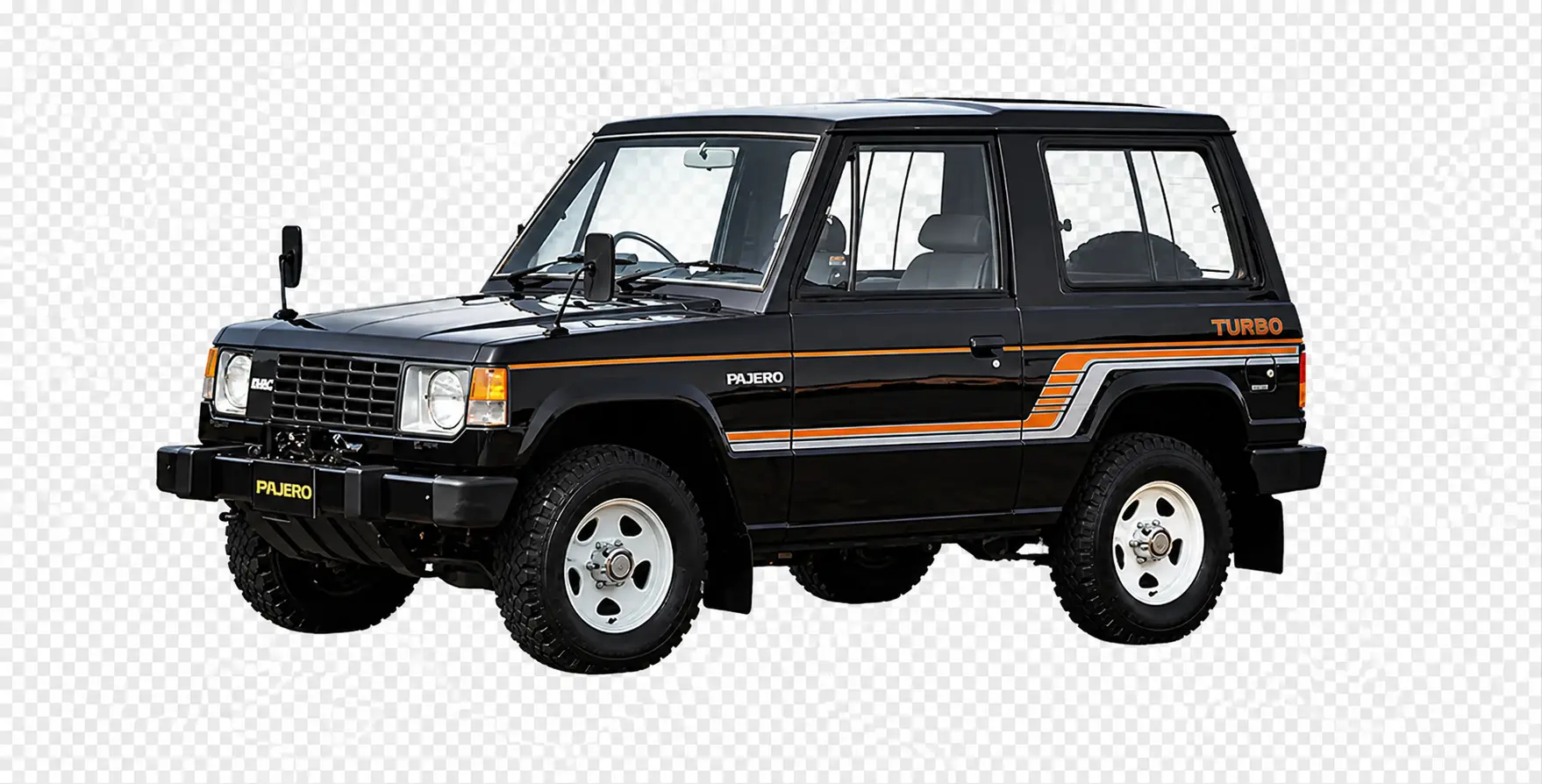
The Pajero That Started It All
When Mitsubishi unveiled the Pajero concept at the 1981 Tokyo Motor Show, nobody fully grasped what they were looking at. A year later, in May 1982, the production Pajero arrived, and within three years it had won the Dakar Rally, the most demanding motorsport event on earth. What followed was a 12-win dynasty that earned a Guinness World Record no other 4×4 will ever match.
In South Africa, the Gen 1 Pajero arrived to a country hungry for capable, affordable 4x4s that could handle the Karoo, the Kgalagadi, and the farm tracks of the Highveld. It delivered. The simple body-on-frame construction with solid axles front and rear meant any competent mechanic could fix it almost anywhere, a crucial quality for SA conditions.
Today, at 35–44 years old, the Gen 1 sits at an interesting junction: too old to be a practical daily driver, too historically significant to ignore, and increasingly too collectible to overlook. The right Gen 1, especially a canvas-top SWB or a well-preserved LWB with full history, is becoming a genuine investment piece in the SA classic 4×4 market.
“The Gen 1 is mechanically honest in a way modern vehicles can’t be. It doesn’t try to hide anything. It’s all there, in front of you, fixable with basic tools.”
| Production | 1982–1991 Japan; exported to SA 1982–1991 |
| Also known as | Mitsubishi Montero (USA/Latin America), Mitsubishi Shogun (UK) |
| Chassis | Body-on-frame · Solid front & rear axles |
| 4WD | Part-time: 2H / 4H / 4L |
| Dakar wins | 1985 · 1992 · 1993 (3 wins from Gen 1 era) |
Evolution: 1982–1991
The Pajero landed as a genuine original. Mitsubishi first showed it as a prototype at the Tokyo Motor Show in October 1981, and production sales began in May 1982. Where most 4x4s of the day were agricultural, the Pajero arrived with a turbocharged diesel option, independent front suspension and power steering, pitching itself as a more civilised, road-friendly alternative to the Range Rover and Toyota Land Cruiser while giving up nothing off-road.
It earned its reputation almost immediately. In 1983 a Pajero driven by Andrew Cowan won its class on the Paris–Dakar Rally, the first chapter of the record-breaking Dakar story that still defines the badge today.
Key milestones
- 1982: Launch of the short-wheelbase three-door, offered with a metal hardtop or a canvas soft top.
- February 1983: The long-wheelbase five-door joins the range, adding seating and load space.
- 1983: Class victory on the Paris–Dakar Rally kicks off the Pajero’s motorsport dynasty.
- 1984: Uprated turbo-diesel power arrives.
- 1985: Four-wheel disc brakes and an optional four-speed automatic are added.
- 1987: The luxury Exceed flagship debuts, pushing the Pajero further upmarket.
- September 1988: A major update brings a 3.0-litre SOHC V6 (105 kW / 143 PS) and an intercooled 2.5-litre turbo-diesel, the first intercooler fitted to a 4×4, plus revised styling.
- January 1991: The first generation bows out as the all-new second-generation Pajero arrives.
One important detail for buyers: the first-generation Pajero used a part-time four-wheel-drive system with free-wheeling front hubs. The famous Super Select full-time system only arrived with the Gen 2 in 1991.
SWB, LWB & the Canvas Top
The Gen 1 was sold in two wheelbases and, unusually for the class, an open-top body, which is a big part of why clean examples are so collectible today.
| Body | Doors | Best for |
|---|---|---|
| SWB (short wheelbase) | 3-door | Agile off-roading, the sharpest approach, departure and breakover angles. The original 1982 body, offered with a metal hardtop or a removable canvas top. |
| LWB (long wheelbase) | 5-door | Family and touring, added rear doors, more cargo space and up to seven seats with the rear jump seats. Introduced February 1983. |
The canvas top
The short-wheelbase canvas-top (soft-top) is the enthusiast’s pick. It gave the early Pajero a lifestyle, semi-convertible character no rival offered, and survivors are now genuinely rare. Rust and perished canvas have claimed most. A tidy, un-cut soft-top SWB is one of the more sought-after first-generation Pajeros in South Africa. Put simply: the SWB, especially the canvas top, is the collector’s car, while the LWB five-door is the more usable everyday classic. For the full breakdown of the trade-offs, see our SWB vs LWB guide.
Gen 1 Engine Guide
At this age, engine choice fundamentally determines ownership experience. The 4D56 2.5TD is the standout option for SA conditions: mechanical injection, robust construction, and decades of parts availability.
| Code | Engine | Power | Torque | Notes | Verdict |
|---|---|---|---|---|---|
| 4D56 | 2.5L Turbo Diesel (from 1986) | 73 kW | 210 Nm | Mechanical indirect injection, simple, rebuildable, widely supported. The SA favourite for reliability. | Best Buy |
| 4D55T | 2.3L Turbo Diesel (early) | 62 kW | ~190 Nm | The original turbo diesel, pre-1986. Less common in SA. Parts increasingly scarce. Functional but superseded by 4D56. | Decent |
| 6G72 | 3.0L V6 Petrol (12v) | 104 kW | 220 Nm | Smooth, responsive V6 introduced 1986. Crank angle sensor a known weak point. Cooling system needs attention at this age. High fuel consumption in SA conditions. | Good Option |
| G54B | 2.6L 4-Cyl Petrol (early) | 82 kW | ~190 Nm | Pre-1986 early models only. Rare in SA. Carburettor-fed, requires specialist knowledge. Avoid unless you have a specific reason. | Avoid |
The 1986–1991 models with the 4D56 2.5TD are by far the most practical Gen 1 purchase for everyday use in South Africa. The mechanical injection system means no expensive electronics to fail on a remote trail, a critical consideration for anyone planning to use the vehicle in the bush. Parts are shared with the Mitsubishi Colt and early Triton, making sourcing straightforward.
Complete Gen 1 Specs
| Production | May 1982 – 1991 |
| Platform | Body-on-frame · Ladder chassis |
| Front suspension | Independent double wishbone, torsion bars |
| Rear suspension | Live axle, leaf springs (SWB) / Coil springs (LWB) |
| SWB wheelbase | 2,350 mm |
| LWB wheelbase | 2,695 mm |
| Ground clearance | ~200 mm |
| SWB approach angle | 44° |
| SWB departure angle | 34° |
| 4WD system | Part-time: 2H / 4H / 4L |
| Transmission | 4 or 5-speed manual / 3-speed auto |
| Towing capacity | 2,000 kg (braked) |
| SWB fuel tank | 65 L |
| LWB fuel tank | 80 L |
| Kerb weight (SWB) | ~1,450 kg |
| Safety | No airbags (era-correct) |
| Dakar Rally wins | 1985, 1992, 1993 |
Known Issues & What to Inspect
Mechanically the first-generation Pajero is simple and tough (body-on-frame, a solid rear axle, and engines shared with Mitsubishi’s commercial range), which is exactly why so many are still working. It’s age and rust, not design flaws, that catch buyers out. Inspect these areas carefully.
Rust: the number-one killer
Corrosion is the single biggest issue on a 30-to-40-year-old Pajero, and early models are especially prone. Check the fuel-tank area, rear wheel arches, door bottoms and frames, under all rubber seals, the roof and sunroof perimeter, and, most importantly, the ladder chassis and body mounts. Coastal and salted-road cars are the worst affected. Surface rust is liveable; structural rust in the frame is a walk-away.
Engine & mechanical checks
- Timing belt (all engines): the Gen 1 diesels (4D55/4D56) and the petrols are belt-driven. A snapped belt is expensive, so confirm it has been changed on schedule, roughly every 100,000 km. No proof? Budget to do it immediately.
- Diesel intake & breather: high-kilometre turbo-diesels bake oil vapour into the intake, sapping power, a clean-out sorts it. A blocked rocker-cover breather/filter causes oil consumption and blue smoke and should be fixed early.
- Oil leaks: rocker-cover and cam/crank seal gaskets go brittle with age and weep. Messy, but cheap to reseal.
- Smoke & cold starts: watch for excessive blue (oil) or black (fuel/turbo) smoke, and listen for injector rattle on a cold start.
Drivetrain & running gear
- Cycle the part-time 4WD through 2H, 4H and 4L and confirm the free-wheeling front hubs lock and the transfer case shifts cleanly, no diff whine or driveline clunk.
- Check the front swivel/CV joints, wheel bearings and torsion bars, and look for oil weeping from the diffs and transfer case.
- Expect tired bushes, dampers and steering components on an un-restored car, all normal wear, but factor it into your offer.
Parts: service and mechanical parts for the diesels are still findable through the aftermarket and used-spares market, but some body panels, trim and canvas-top hardware are getting scarce. A well-kept example is worth paying more for than a cheap project.
Sources
- Wikipedia: Mitsubishi Pajero (history, body styles, engines and dates)
- ReDriven: Used Mitsubishi Pajero review (known issues, timing belt, rust and inspection points)
- CarsGuide: Mitsubishi Pajero problems & reliability
- autoevolution: Mitsubishi Pajero 5-door (1982) specifications
What to Pay
The Gen 1 market in South Africa is strengthening. Classic 4×4 appreciation is real. A well-preserved original is now a collector asset, not just an old truck.
The Gen 1 Pajero is at a pivotal moment in its life cycle. It’s old enough to be genuinely mechanically challenging to maintain, but young enough that good examples still exist at reasonable prices. The canvas-top SWB is already a collector piece. The LWB with a 4D56 diesel and documented history is an honest, capable vehicle that will go almost anywhere with appropriate preparation. Buy with full knowledge of the maintenance commitment required, and buy the best example you can afford. The Gen 1 that needs work will always need more work than you budget for. The clean one you pay more for upfront will cost you far less over time.
The Gen 1 era Pajero claimed three Dakar Rally overall victories, in 1985, and then again in 1992 and 1993 with evolved Gen 1-derived machinery. That first win in 1985 proved the Pajero’s engineering to the world. Total Pajero Dakar wins across all generations: 12, a Guinness World Record.
Gen 1 Resources
- Pajero Owners Club of South Africa: SA forum for first-generation restoration, parts sourcing and buying advice.
- 4x4Community.co.za: active South African 4×4 forum with a classic-Pajero following.
- Pajero 4WD Club of Victoria: deep technical archive for the early 4D56 diesel and 4G-series petrols.
- Mitsubishi Pajero/Shogun Owners Club (UK): restoration know-how for the round-headlight generation.
- On this site: SWB vs LWB · Super Select 4WD · Pajero specifications · Dakar history