
The fifth-generation Mitsubishi Pajero is real, it is finished, and it is coming to South Africa. Mitsubishi revealed it on 2 September 2026, opened Australian order books the following day, and Mitsubishi South Africa has confirmed local arrival by the end of 2027. This page is the full picture: what is confirmed, what it costs where it is already on sale, what that implies for rand pricing, and what it means if you already own a Pajero.
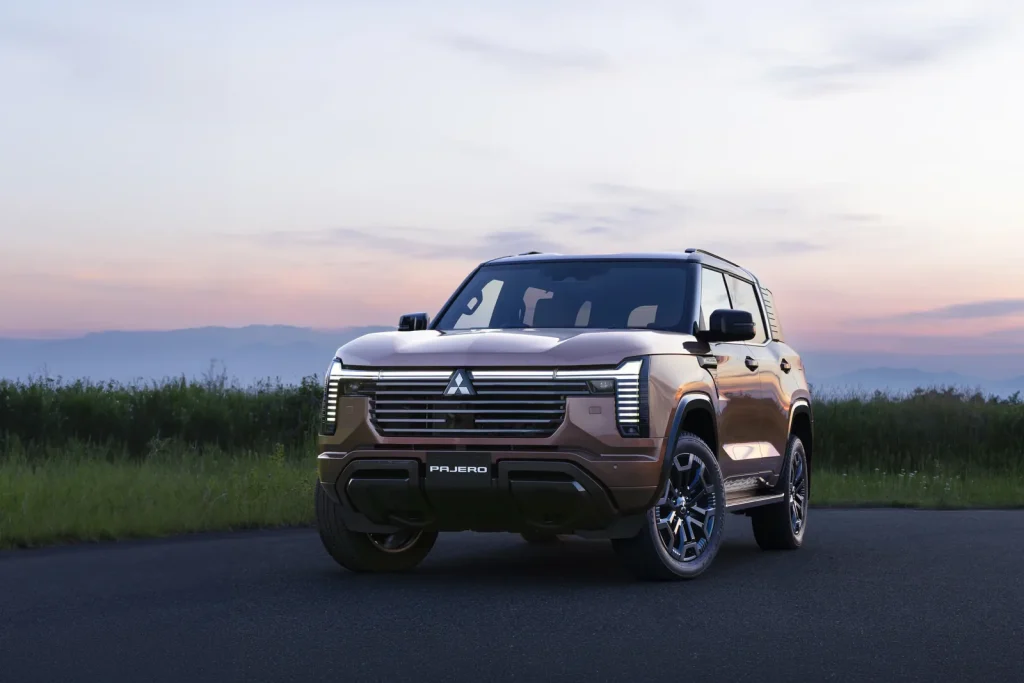
The short answer
- Engine: 2.4-litre 4N16 turbo-diesel, 150 kW and 480 Nm, eight-speed automatic. No V6, and none planned.
- Drivetrain: Super Select 4WD-II with 2H, 4H, 4HLc and 4LLc, plus S-AWC and a rear diff lock.
- Chassis: ladder frame, double-wishbone front, five-link rigid rear axle.
- Off-road: 230 mm ground clearance, 30.4 degree approach, 22.6 breakover, 25.8 departure.
- Towing: 3.5 tonnes braked in Australian specification.
- South Africa: confirmed for local sale by the end of 2027. No local pricing, trim walk or final specification announced yet.
- Australian pricing: from A$68,490 to A$84,990 before on-road costs, which is the only real price anchor that exists today.
What has changed since the reveal
Most of the coverage you will find was written on reveal day and has not moved since. Quite a lot has happened in the weeks after, and it changes the picture for buyers.
- 2 September 2026: world premiere. Mitsubishi confirms the ladder frame, Super Select II, the 2.4 diesel and the eight-speed automatic. Power is not stated on the day.
- 3 September 2026: Australian pricing lands and order books open. Outputs are confirmed at 150 kW and 480 Nm.
- 25 September 2026: Mitsubishi Australia opens its pre-order campaign to customers, with three complimentary scheduled services valued at up to A$1,497 and a A$1,000 accessory pack for orders placed before 15 December and delivered by 31 March 2027.
- Mid-September 2026: Mitsubishi rules out a V6 for this generation, and describes electrification as something still being studied.
- 16 September 2026: Australian expressions of interest reach 7,840, of which 3,982 were logged before anyone had seen the car.
- Late September 2026: the first international drive reviews appear. The chassis and cabin are praised, the engine is judged adequate rather than muscular.
The confirmed specification
These are the figures Mitsubishi has published or confirmed through the Australian launch. Where a figure is market-specific, it is marked.
| Engine | 2.4-litre 4N16 four-cylinder turbo-diesel, single variable-geometry turbo, water-cooled intercooler, dual-loop EGR |
| Power and torque | 150 kW and 480 Nm (470 Nm in some market specifications) |
| Emissions | First Mitsubishi engine certified to Euro 6d |
| Transmission | Eight-speed automatic with low-range transfer case |
| 4WD system | Super Select 4WD-II: 2H, 4H, 4HLc, 4LLc, plus rear differential lock |
| Dynamics | S-AWC with Active Yaw Control; seven drive modes (Normal, Eco, Gravel, Snow, Mud, Sand, Rock) |
| Suspension | Double wishbones front, five-link rigid axle rear, disc brakes all round |
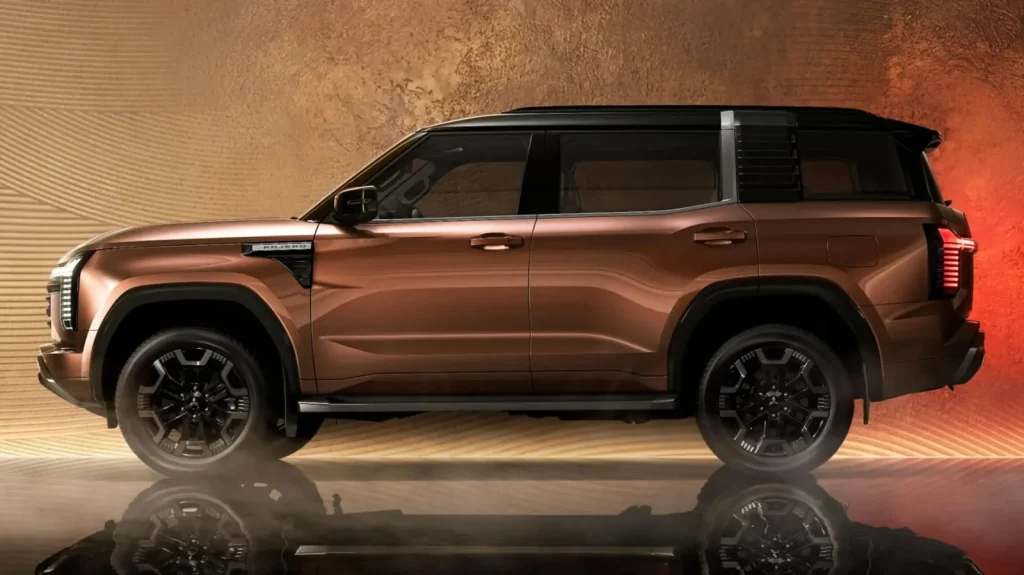
| Dimensions | 4,920 mm long, 1,925 mm wide, 1,910 mm tall, 2,870 mm wheelbase |
| Ground clearance | 230 mm |
| Angles | 30.4 degrees approach, 22.6 breakover, 25.8 departure (quoted on 20-inch tyres) |
| Towing | 3,500 kg braked with Trailer Load Assist (Australian specification) |
| Fuel tank | 80 litres |
| Seating and boot | Five and seven-seat layouts, 150 mm second-row slide, 519 litres with the third row folded, 10-litre underfloor box |
| Screens | Twin 12.3-inch displays on lower grades, twin 14.3-inch on higher grades |
| Safety | Eight airbags including front-centre and third-row curtains, MI-PILOT adaptive cruise with lane keeping, AEB with pedestrian and cyclist detection, rear AEB, blind-spot warning, 3D Multi Around Monitor |
| Off-road cameras | Digital See-Through Bonnet, projecting the ground beneath the vehicle onto the centre screen, plus the 3D Multi Around Monitor |
| Production | Thailand first, then Japan and Australia, reaching roughly 100 countries from 2027 |
The engine question: 150 kW, and no V6
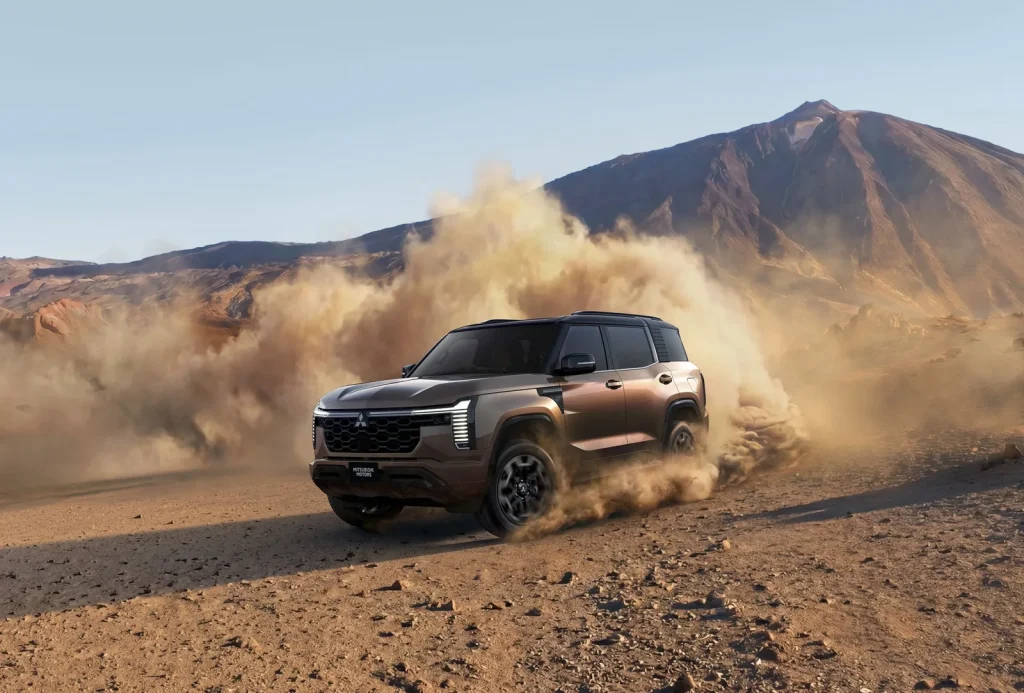
This is the part of the car South African buyers argue about, so it is worth being precise. The new Pajero uses one engine: the 2.4-litre 4N16 turbo-diesel, making 150 kW and 480 Nm through an eight-speed automatic. It is a development of the 4N15 family already familiar from the Triton and the Pajero Sport, with a single variable-geometry turbo rather than the bi-turbo arrangement some reports predicted before the reveal.
There is no six-cylinder coming. Kunitoshi Itagaki, chief product specialist in Mitsubishi’s product strategy division, was unambiguous: the company has “no additional powertrain plans at this moment, including a turbocharged V6 gasoline engine”. Mitsubishi says the choice came down to market needs, regulation, performance, fuel economy and driving range.
Electrification is being studied rather than scheduled. Itagaki has said Mitsubishi “will continue to study the best future options, including maybe electrification”, with the caveat that anything electrified still has to deliver the towing, off-road ability and durability the badge implies. Read that as the 2.4 diesel carrying this generation for the next two to three years at least.
For context, 150 kW puts the Pajero exactly level with the Toyota Land Cruiser Prado and comfortably ahead of the Isuzu MU-X at 140 kW, but 34 kW behind the 3.0-litre V6 Ford Everest. On torque, 480 Nm beats the MU-X’s 450 Nm and trails the GWM Tank 500’s 620 Nm. The honest reading is that this is a competitive mid-pack diesel rather than a class-leading one, and the early drive reviews say the same thing.
Super Select II survives, with S-AWC layered on top
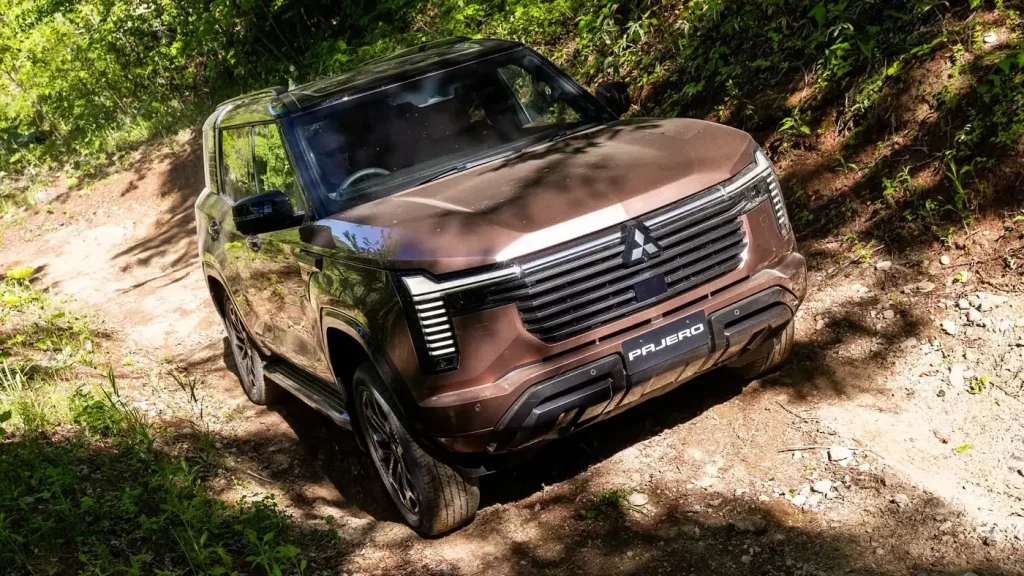
The single biggest question before the reveal was whether the new Pajero would keep Super Select, or drop to the part-time system used by most of the segment. It keeps it. All four modes are intact: 2H for rear-wheel drive on tar, 4H as full-time four-wheel drive with an open centre differential that is safe on any surface, 4HLc with the centre diff locked, and 4LLc for low range. A rear differential lock is fitted.
The other genuinely new piece of off-road equipment is the digital See-Through Bonnet. Cameras under the front of the vehicle feed a composite image to the centre screen that appears to show the ground underneath it, including where the front wheels are sitting. On a rocky climb or a badly rutted track this is the difference between placing a wheel and guessing at it, and it is the sort of thing that matters far more in practice than another ten kilowatts.
What is new is S-AWC, Mitsubishi’s vehicle dynamics layer, working over the top with Active Yaw Control and seven terrain modes. Super Select handles the mechanical distribution of drive, S-AWC manages how the vehicle behaves within it. If you want the detail on why the full-time option matters on South African roads, where a single trip can mix wet tar, dirt district roads and sand, our guide to Super Select 4WD covers each mode and when to use it.
Inside: screens, seats and space
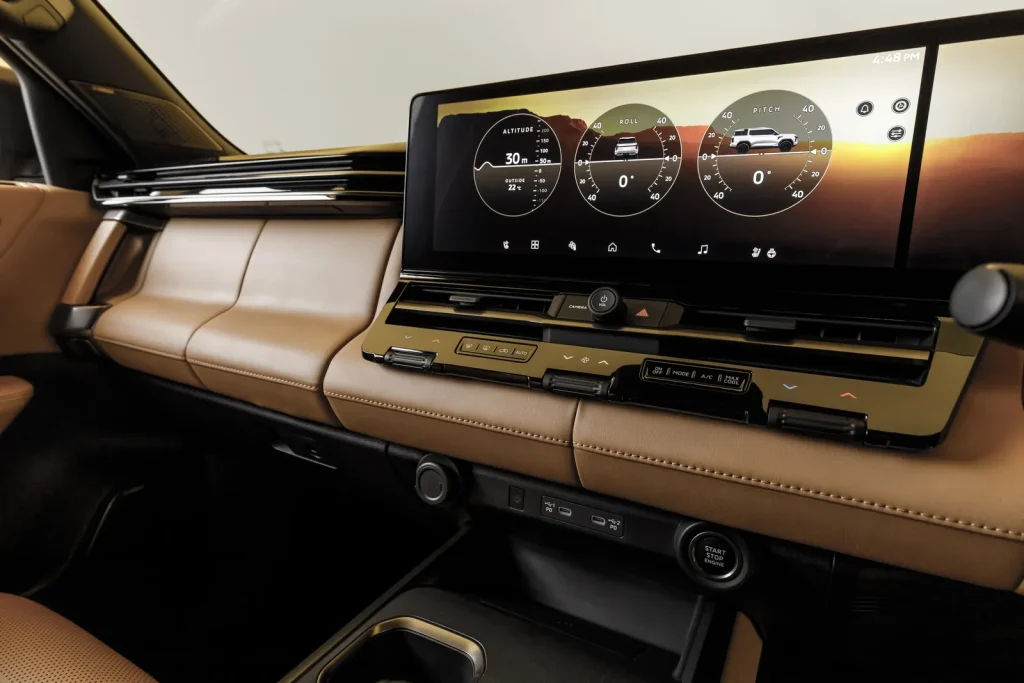
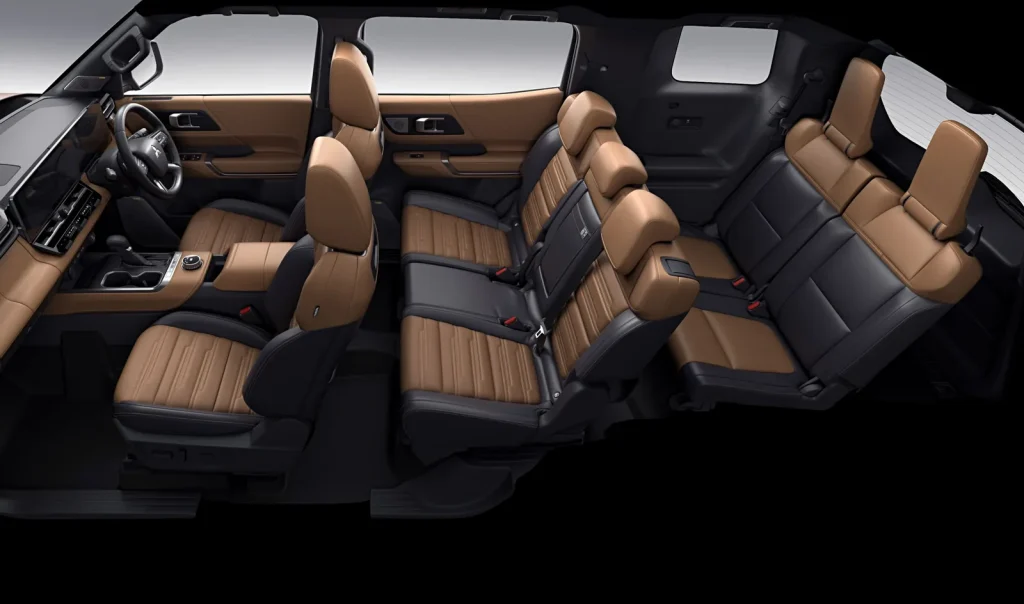
Two screens dominate the dashboard, 12.3 inches each on lower grades and 14.3 inches on the higher ones, and the off-road Multi Meter that defined the classic Pajero returns as a digital display of altitude, roll and pitch. Seven and five-seat layouts are offered, the second row slides through 150 mm, and the boot holds 519 litres with the third row folded, with a 10-litre underfloor box for the muddy things you do not want loose in the cabin.
What it costs, and what that implies for South Africa
Australia is the only market with published retail pricing, so it is the only sensible anchor. The ladder there runs from A$68,490 for the five-seat GLS to A$84,990 for the GSR, all before on-road costs.
| Grade | Australian price (before on-road costs) |
|---|---|
| GLS five-seat | A$68,490 |
| GLS seven-seat | A$69,990 |
| Exceed | A$79,990 |
| GSR | A$84,990 |
Converting that directly into rand is the wrong way to estimate a South African price, because duties, homologation, specification and local positioning all move the number. The useful signal is where Mitsubishi chose to place the car against its rivals. In Australia the Pajero undercuts the base Toyota Prado GX at A$73,200 and sits slightly above the cheapest Ford Everest V6 at A$66,990. That is a deliberate position: priced under the Prado, level with or just above a V6 Everest.
Apply the same logic to South African pricing, where the Everest 3.0TD V6 4WD starts at R1,149,000 and the Prado at R1,369,200, and the new Pajero lands somewhere in the R1.1 million to R1.3 million band for the core models. Treat that as our reasoning rather than a quote: Mitsubishi South Africa has published nothing, local specification is unconfirmed, and a year of currency movement sits between now and launch. We work through the estimate properly, including the cheaper-variant scenario, in our New Pajero price South Africa analysis.
One more Australian detail worth noting because it signals intent: the car is sold there with a conditional 10-year, 200,000 km warranty and 10 years of capped-price servicing. Whether that travels to South Africa is unknown, but it tells you Mitsubishi is buying its way back into a segment it left.
South Africa: what is confirmed and what is not
Mitsubishi South Africa has confirmed the new Pajero is coming, and CAR magazine reported on reveal day that the local arm expects it by the end of 2027. AutoTrader South Africa, reporting the same confirmation, noted that local pricing, launch timing and final specification have not been announced. Both things are true at once: the car is confirmed, the detail is not.
The late-2027 timing is consistent with Mitsubishi’s own global rollout. Production starts in Thailand, with Japan and Australia following, and distribution widening to roughly 100 countries from 2027. South Africa has historically been supplied from Thailand, the same source as the current Pajero Sport and the Triton, which is the practical reason to expect a Thai-built car here rather than a Japanese one.
Realistically, that means first local deliveries late in 2027, with pricing announced perhaps two to three months before. If Australian demand is any guide, early allocation will be thin: 7,840 Australians had registered interest by 16 September, nearly 4,000 of them before the car was even shown.
No spam, just the launch news. We log basic technical data (IP address and approximate location) to prevent abuse. See our Privacy Policy.
How it lines up against the South African rivals
Rand prices below are current South African retail figures for the rivals. The Pajero row is what has been confirmed globally, with local pricing still to come.
| Model | Power / torque | SA price from |
|---|---|---|
| Mitsubishi Pajero (2027) | 150 kW / 480 Nm | Not yet announced |
| Toyota Land Cruiser Prado | 150 kW | R1,369,200 |
| Ford Everest 3.0TD V6 4WD | 184 kW | R1,149,000 |
| GWM Tank 500 3.0TD 4WD | 170 kW / 620 Nm | R929,900 |
| Isuzu MU-X 3.0TD 4WD | 140 kW / 450 Nm | R939,700 |
On paper the Pajero is not the most powerful and will not be the cheapest. What it brings is the combination the rest of that table cannot match in full: a full-time 4WD system usable on tar, low range, a rear diff lock, a rigid rear axle and 230 mm of clearance, in a seven-seat body from a brand with a service network in the small towns where this matters. Our head-to-head against the Fortuner and Prado goes through that trade-off in detail.
What it means if you own a Pajero now
If you are in a Gen 4, the return of the nameplate is mildly good news for values. A live model in showrooms keeps a badge visible, keeps parts moving and keeps the community intact, and the 2021 to 2026 gap is precisely what made clean Gen 4s scarce. It does not rescue a tired, high-kilometre car: buyers still pay for provenance. We cover that properly in is your Gen 4 still worth keeping.
If you are in a Pajero Sport, the new car sits clearly above it rather than replacing it like for like. In Australia the Pajero Sport was discontinued in 2025 and the new Pajero indirectly succeeds it, at a considerably higher price. South Africa still sells the Pajero Sport, so the likeliest local outcome is the two models coexisting for a period, with the Pajero as the flagship.
The wider Pajero family
Mitsubishi has been open that the Pajero is becoming a family of vehicles rather than a single model. Beyond the five-door flagship covered here, reporting on Mitsubishi’s product plans points to a compact Pajero-badged crossover around 2028 to 2029, and a kei-sized model toward 2030. Neither has been shown, and neither has been confirmed for South Africa.
That strategy has history. Mitsubishi has used the Pajero name across small vehicles before, from the Pajero Mini and Junior to the iO and Pinin, which we cover in our piece on the small Pajeros. The point worth holding onto is that a future compact Pajero will not be a shrunken version of this ladder-frame flagship.
Why the Dakar record still matters here
Mitsubishi leans on the Dakar record in almost every piece of Pajero communication, and for once the marketing is earned: 12 outright wins, including seven consecutive from 2001 to 2007, a Guinness World Record no manufacturer has matched. The engineering lesson from that era, that a simple, strong drivetrain with a usable full-time 4WD system survives punishment better than a clever one, is visible in this car’s specification. The full story is in our Dakar history and 44 years of Pajero.
Frequently asked questions
Is the Mitsubishi Pajero coming back?
Yes. The fifth-generation Pajero was revealed on 2 September 2026 after a five-year absence, and goes on sale in its first markets from December 2026. Mitsubishi South Africa has confirmed it for local sale by the end of 2027.
How much will the new Pajero cost in South Africa?
Mitsubishi South Africa has not announced pricing. Based on where the car is positioned against the Prado and Everest in Australia, and current South African prices for those rivals, we expect the core models to land between roughly R1.1 million and R1.3 million. That is an estimate with a year of currency movement still to run, not a quoted price.
What engine does the new Mitsubishi Pajero have?
A 2.4-litre 4N16 four-cylinder turbo-diesel producing 150 kW and 480 Nm, matched to an eight-speed automatic. It is the only engine, and Mitsubishi has ruled out a V6 for this generation.
Does the new Pajero still have Super Select 4WD?
Yes. Super Select 4WD-II is fitted with all four modes, 2H, 4H, 4HLc and 4LLc, plus a rear differential lock, with S-AWC and seven terrain modes layered over it.
Will there be a hybrid or plug-in Pajero?
Not at launch, and not on a confirmed schedule. Mitsubishi says it continues to study electrification for the Pajero, but insists any electrified version must keep the towing, off-road ability and durability of the diesel. Expect the 2.4 diesel to carry the range for at least two to three years.
Is there a three-door Pajero?
No. Renderings of a short-wheelbase three-door have circulated widely, but they are independent artist illustrations, not Mitsubishi products. The new Pajero is a five-door only. Mitsubishi has separately signalled smaller Pajero-branded models later this decade.
Is the new Pajero just a Triton with a different body?
No, though it shares the Triton’s engineering roots. The ladder frame’s front section is shared, with the rest of the structure specific to the Pajero, and the rear suspension is a five-link rigid axle rather than the ute’s leaf springs. Mitsubishi describes the frame as significantly modified beneath the Pajero.
Sources
- Mitsubishi Motors Corporation, all-new Pajero news release, 2 September 2026
- CAR magazine South Africa, 2027 Mitsubishi Pajero revealed and confirmed for South Africa, and its rivals comparison of 9 September 2026, for South African rival pricing
- AutoTrader South Africa, new Mitsubishi Pajero confirmed for South Africa
- carsales.com.au, Pajero GLS 2027 first drive, and its report on Mitsubishi ruling out a V6
- Drive.com.au, expressions of interest and pre-order detail, 18 September 2026
- Mitsubishi Motors Australia, “Pajero Unpacked” customer email, 25 September 2026, for the See-Through Bonnet and the pre-order offer terms
We update this page as Mitsubishi confirms detail, and we will publish South African pricing and specification the day it is announced rather than repeating speculation. If you spot something that has changed, tell us and we check and credit every correction.