
If Mitsubishi South Africa sold your Pajero new, it does not have a diesel particulate filter. Not a 2009, not a 2012, not the last Legend 100 off the boat in 2021. There is no filter in the exhaust, no regeneration cycle, and no way to clog something that was never fitted.
That is the short answer, and it contradicts a great deal of what is written about the Pajero online, including several pages on this site. The correction is below, along with what to do if you own one of the cars that genuinely does have a filter, because those are here too.
A correction to our own pages
Our 3.2 DI-D common problems guide has told readers that DPF clogging affects “post-2008 Gen 4 models”. Our daily driver article advised buying a “pre-DPF Gen 4, 2006 to approximately 2008”. Our Gen 4 buyer’s guide says post-2011 in one place and 2017 in another. Three other pages repeat a “2007 to 2015 pre-DPF window”.
Those are wrong for a locally delivered car, and the advice they produced was worse than useless: readers have been told to pay a premium for an early Gen 4 to dodge a component that was never fitted to the later ones either. Two newer pages on the site, the 2016 and 2018 buying guides, got it right. The rest were written earlier and inherited an assumption from overseas sources.
We publish corrections rather than quietly editing them, so this article is the correction. The affected pages are being updated to point here.
Why South Africa never got the filter
It comes down to fuel, and it is not really a Mitsubishi decision at all.
South Africa sells two grades of diesel under SANS 342. Standard grade is capped at 500 parts per million of sulphur. Low sulphur grade is capped at 50 ppm. Where a pump carries no sulphur marking, the industry position is to assume it is the 500 ppm grade.
A diesel particulate filter cannot live on 500 ppm fuel. Sulphur poisons the oxidation catalyst that sits ahead of the filter and raises its light-off temperature, and it converts to sulphates that load the substrate as ash, which no regeneration cycle removes. Ash is the component that eventually ends a filter’s life regardless of how it is driven. Feed it high-sulphur diesel and that end arrives much sooner.
The regulatory side matches. South Africa’s national exhaust emissions standard for new vehicles has been Euro 2 since 2006 and has not been updated since. Euro 2 does not require a particulate filter on a passenger diesel. Clean Fuels 2, which drops the national diesel sulphur limit to 10 ppm, is gazetted to take effect on 1 July 2027, having slipped repeatedly from an original 2017 target. That single fact explains a long list of Euro 5 and Euro 6 diesels that were never sold here.
There is a useful corroborating detail in the local specifications. Mitsubishi South Africa quoted 140 kW for the 3.2 DI-D from the MY10 update right through to the final Legend 100 run in 2021. In the markets that did fit a filter, the equivalent update is reported to have cost around 4 kW of peak power, because a filter is a restriction and the calibration pays for it. A local figure that never moves across fifteen years is a reasonable indication that the local exhaust never changed. CAR magazine’s launch test of the SWB Legend II describes the engine as 500 ppm compatible, which is the same statement from the other direction.
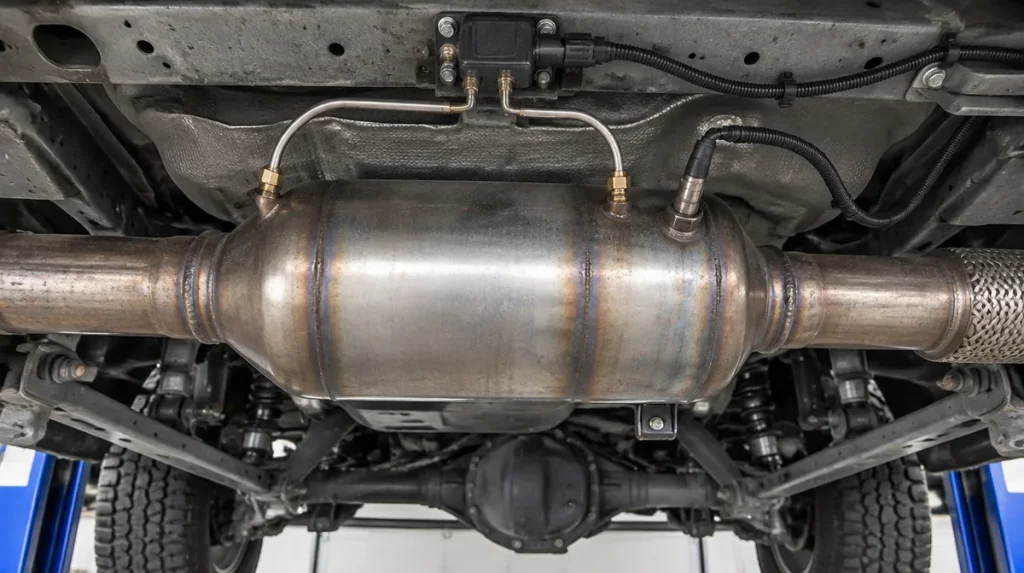
How to settle it on your own vehicle in five minutes
Model year does not answer this question. Origin does, and the only answer worth having is the one you get from the car in front of you. Grey imports from Japan, Australia and the United Kingdom are a real part of the SA Pajero market, and some of those do carry a filter.
- Look underneath. A DPF is a fat canister in the exhaust, downstream of the turbo and ahead of the mid pipe, noticeably larger in diameter than the pipe either side of it. A car without one has a plain catalytic converter or straight pipe in that position.
- Look for the sensor lines. This is the giveaway. A filter has two small steel pipes running to a differential pressure sensor, usually bracketed to the body above, and at least one exhaust gas temperature sensor threaded into the housing. No sensor lines, no filter.
- Read the handbook. Mitsubishi prints a DPF section in the owner’s manual only for vehicles fitted with one. A handbook with no DPF pages is a strong signal, provided it is the book that came with that car.
- Plug in a scan tool. A filter-equipped ECU reports soot loading, differential pressure, exhaust gas temperature and a regeneration count. A local car returns nothing for any of them.
- Check the car’s history, not its year. A natural-aspirated service book, a Mitsubishi South Africa VIN and a local first registration together mean no filter. A Japanese auction sheet means check properly.
If you are buying rather than diagnosing, this belongs on the same list as the checks in our used Pajero buyer’s guide. It takes a torch and a minute on your back.
Which markets fitted one, and when
This is where the internet’s confusion comes from, and it is worth being honest about: the sources genuinely conflict, and the fitment history is not a straight line. The filter went on, came off, and in at least two markets went back on again.
| Market | What the sources say | Confidence |
|---|---|---|
| South Africa | No filter on any Gen 3 or Gen 4, 2000 to 2021 | High |
| Australia | Early NS turbo-diesels had one; CarsGuide reports Mitsubishi dropped it “for 2009 and beyond after problems with the technology”. Club forum posts describe an early NT passive unit deleted around the MY10 change, placed by one poster at about September 2010. A filter is then reported back on the NX from roughly October 2016 | Medium |
| United Kingdom and Europe | Euro 4 filters catalogued for roughly 11/2006 to 08/2008, Euro 5 units for roughly 2009 to 2015. One owners’ club post describes 2010 Euro 4 cars carrying a non-regenerating filter with “the dreaded DPF” returning on the 2012 Euro 5 cars | Medium |
| Japan domestic | We have not established this and will not guess | None |
Two cautions on that table. Aftermarket parts catalogues are the worst source available for fitment dates, because sellers widen a range to catch more searches, and several of the listings above contradict each other outright on the same chassis code. And the October 2016 NX date reaches us through a reader, Wilson, citing Mitsubishi’s own launch material and Australian workshop documentation; we could not corroborate it in any public Mitsubishi source, although Australian wreckers do list filters pulled from 2017 cars.
What survives all of that is the shape rather than the dates: fitment is decided by market and emissions regulation, not by model year. A 2008 Shogun in Britain and a 2008 Pajero in Gauteng are not the same vehicle.
If your car does have one: how the system actually works
The filter is a ceramic honeycomb with alternate channels plugged, so exhaust gas is forced through the porous walls and soot is trapped on them. The ECU watches the pressure drop across the filter and counts soot loading. As the load rises, the filter is burned clean in a process called regeneration.
There are two ways that happens.
- Passive regeneration is free. Sustained load raises exhaust gas temperature high enough that soot oxidises on its own. This is what a highway run does, and the driver never knows it happened.
- Active regeneration is the ECU deliberately raising exhaust temperature by injecting extra fuel late in the cycle, after the main combustion event. That fuel burns in the exhaust rather than the cylinder and lifts the filter to the 550 to 650 degree range needed to light the soot off.
Mitsubishi Australia’s owner guidance is that an automatic regeneration needs roughly 40 km/h or more with the engine at operating temperature, and that it should complete within about 100 km of being requested. The widely repeated “20 to 30 minutes above 60 km/h” is a reasonable rule of thumb for the same thing.
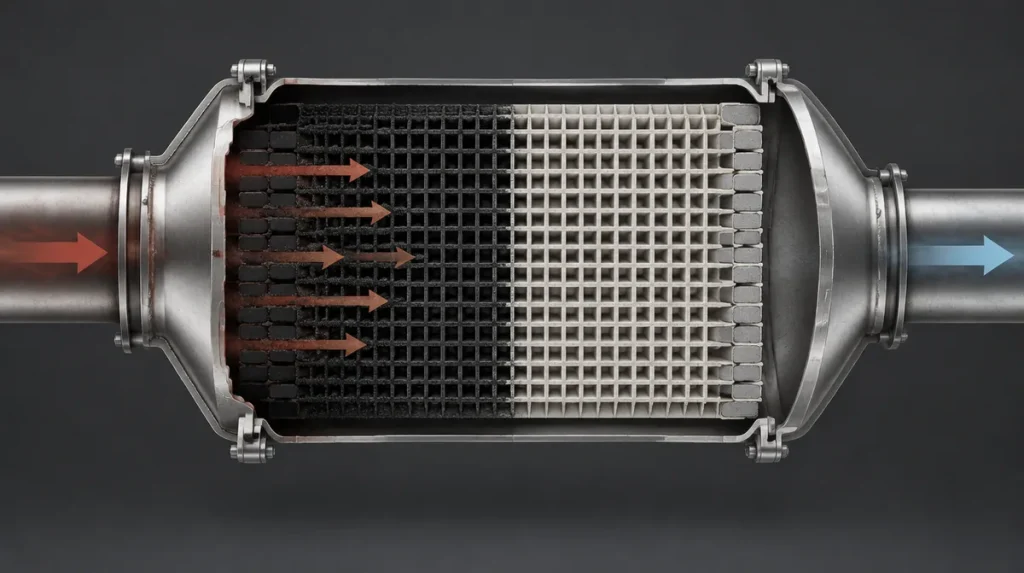
The failure mode everyone describes is the obvious one. Short trips mean the engine rarely reaches temperature, active regenerations are requested and then interrupted by the key being turned off, soot loading climbs, and eventually the filter restricts exhaust flow badly enough to trigger a warning light, cut power and put the vehicle into limp mode. Owners also report intake and MAP sensor faults producing an identical limp mode on these engines, which is worth remembering before a filter is condemned. The soot that blocks a filter is the same soot covered in our EGR and inlet manifold guide, arriving at a different place in the system.
The failure nobody warns you about: diesel in the sump
This is the part of DPF ownership that gets left out of the buying guides, and on the 4M41 it is the one that can end an engine rather than a filter.
Active regeneration works by injecting fuel late, when the cylinder wall is exposed and the piston is well down the bore. Some of that fuel does not burn. It washes down the bore, past the rings, and ends up in the sump. One regeneration does almost nothing. A car that requests regenerations constantly, and especially one that has them interrupted and restarted, accumulates diesel in its oil.
What that looks like in practice, from a documented case on a high-mileage NS 4M41 with a freshly rebuilt engine: after 3,000 km the owner found the oil level “so high like 4 times the normal level”, and a laboratory analysis returned 28 percent fuel dilution. The filter’s own counter showed 119,979 km and 681 regenerations. Differential pressure sat at 1.5 to 2 kPa at idle and reached 33 kPa on a loaded highway run. After the filter was cleaned and the system reset, the interval between regeneration requests stretched from about 150 km to 250, then 280, 310 and 340 km, and the oil level returned to normal.
Diesel in the oil does three things, in rising order of seriousness. It thins the oil, so bearing and turbo film strength drop. It raises the level, which on a wet-sump engine eventually puts the crank into the oil. And at sufficient dilution the engine can draw its own sump oil in as fuel and run uncontrolled on it, which is not survivable.
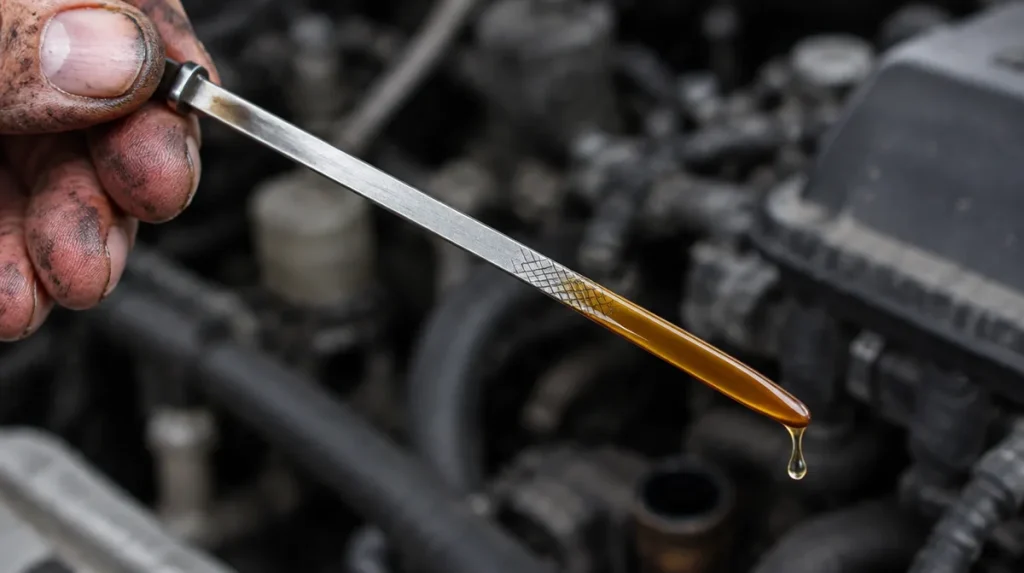
Owners report that Mitsubishi treats the “X” mark on the dipstick as the dilution limit, with an oil change required once the level reaches it, and dealers declining to act while the level sits below it. Treat that as the manufacturer’s threshold rather than a safe operating target. A rising oil level on a DPF car is never normal and never evaporates: diesel boils well above oil’s working temperature and leaves only with the oil.
Three habits deal with almost all of it. Check the level cold and on level ground every month, not at service intervals. Do not switch off mid-regeneration if the car gives you any indication one is running. And shorten the oil interval on a car that lives in traffic, which our maintenance schedule already recommends for other reasons.
Symptoms, in the order they appear
| Stage | What you notice | What to do |
|---|---|---|
| Normal | Occasional change in idle note, cooling fan running on, a faint hot smell after a drive, slightly higher consumption for a tank | Nothing. That is a regeneration doing its job |
| Early | DPF light on but no power loss, regenerations noticeably more frequent, oil level creeping up the dipstick | Drive it at sustained speed for 30 to 40 minutes. If the light clears, fix the driving pattern |
| Middle | Light stays on after a highway run, engine light joins it, noticeably down on power | Scan it. Read soot loading and differential pressure before anyone quotes you. A forced regeneration may clear it |
| Severe | Limp mode, heavy loss of power, regeneration refused by the ECU | Stop driving it. Check the oil level first, then have the filter assessed off the vehicle |
One warning on the middle stage. A blocked inlet or a failed MAP sensor produces the same power loss on a 4M41, and our injector guide describes a third fault that reads the same way to a driver. Diagnose with live data. On these engines, assuming is expensive.
What it costs in South Africa
| Work | Indicative cost | Note |
|---|---|---|
| Diagnostic scan and live data | R500 to R1,500 | Do this first, always |
| Forced regeneration on the vehicle | Workshop labour, typically an hour or two | Only works while the filter is still serviceable |
| Professional off-vehicle cleaning | R5,000 to R12,000 | Removes ash, which regeneration cannot |
| Replacement filter | R40,000 to R50,000, OEM units reported to R100,000 | Sources conflict, see below |
| Removal and remap | R4,000 to R6,000 | See the section below before you consider it |
The replacement figure needs a flag. A South African analysis published in November 2025 puts a new filter at R40,000 to R50,000 with OEM units reaching R100,000. Our own earlier research found local quotes from R5,000 for aftermarket units. Both can be true, because an aftermarket canister and a Mitsubishi part are not the same thing and the Pajero’s filter is not a high-volume local line. Get three quotes and ask explicitly whether the price is OEM, and whether cleaning the existing unit has been assessed first. Our parts sourcing guide covers how that market works.
Worth knowing before you price a replacement: ash loading is reported to force cleaning or replacement from somewhere past 115,000 km on a filter’s life, independent of how carefully it is driven, and South African fuel brings that forward.
The delete question, unresolved
We took the same position on EGR blanking and it has not changed: the South African legal position is genuinely unsettled, and anyone telling you otherwise with confidence is usually selling the service.
What is established:
- Removing the filter is an alteration to a vehicle’s emissions control system. A 2025 South African analysis argues this creates exposure under the National Road Traffic Act as a roadworthiness question, and under the National Environmental Management: Air Quality Act on the emissions side. Neither argument cites a section, and we are not aware of a South African ruling applying either one to a DPF.
- An older South African workshop article states plainly that removal is “not yet illegal” here. It is roughly eight years old.
- South African roadworthy testing does not inspect for the presence of a filter, the way a UK MOT has since 2014. That is an enforcement gap, not a legal permission.
- Most confident “it’s illegal” material online is British or American and cites British or American regulations. The UK’s Construction and Use Regulations have no South African equivalent that anyone has pointed us to.
Two practical points sit outside the legal argument entirely. Insurers require disclosure of material modifications, and a removed emissions component is one, so an undisclosed delete is a reason to decline a claim. And a deleted car is harder to sell, particularly to a buyer who would rather not inherit someone else’s remap.
If you are considering it because the filter is genuinely finished and a replacement costs more than the car is worth, that is a real position and we are not going to pretend otherwise. Price the cleaning first. It is the option most owners skip and it resolves a large share of cases.
What we have not been able to establish
Three gaps, stated rather than filled:
- Japanese domestic market fitment. JDM imports are a meaningful slice of the SA Pajero pool and we have no reliable source on which of them carry a filter. If you have imported one and checked, we would like the chassis code and the answer.
- The exact Australian and UK changeover dates. Parts catalogues disagree with each other and with owners. A page from a factory parts catalogue or a workshop manual would settle it.
- A confirmed South African DPF replacement invoice. Every rand figure above is a quote or a published estimate. One real invoice for a Pajero, with the part number on it, is worth more than all of them.
Send any of it through the contact page and it goes into the article with a credit.
The bottom line
For the overwhelming majority of Pajero owners in South Africa, the DPF is a problem they do not have, and the buying advice built on it was costing them money. Stop paying a premium for an early Gen 4 to avoid a filter, and spend the inspection effort on the things that genuinely do fail on a 4M41: the timing chain guide, the inlet carbon, the injectors and the turbo vanes.
If you are looking at an import, check underneath for the canister and the sensor lines before you talk price. And if you own one, the filter itself is rarely what gets you. The oil level is.
Frequently Asked Questions
Does my South African Pajero have a DPF?
If it was sold new by Mitsubishi South Africa, no, at any year from 2000 to the end of production in 2021. South Africa’s new vehicle emissions standard has been Euro 2 since 2006, which does not require a particulate filter, and standard grade local diesel is capped at 500 ppm sulphur under SANS 342, which a filter cannot tolerate. Privately imported Japanese, Australian and British cars are a different matter and must be checked individually.
How do I check whether a Pajero has a DPF fitted?
Look under the vehicle for a wide canister in the exhaust between the turbo and the mid pipe, and specifically for two small steel pipes running from it to a differential pressure sensor plus an exhaust gas temperature sensor threaded into the housing. No sensor lines means no filter. A scan tool confirms it: a filter-equipped ECU reports soot loading, differential pressure and a regeneration count, and a local car reports none of them.
Which Pajero years were fitted with a DPF?
There is no answer by year alone, because fitment followed each market’s emissions regulations. Australian sources describe a filter on the early NS, its removal for 2009 and beyond, and a return on the NX from about October 2016. UK and European catalogues list Euro 4 filters for roughly late 2006 to 2008 and Euro 5 units from about 2009 to 2015. South Africa fitted none at all. The sources conflict on exact dates, so inspect the vehicle rather than trusting a year.
Why does my oil level go up on a DPF Pajero?
Active regeneration injects extra fuel late in the combustion cycle to heat the filter, and some of that fuel washes past the piston rings into the sump. Frequent or interrupted regenerations accumulate it. A documented case on a 4M41 returned 28 percent fuel dilution by laboratory analysis with the level around four times normal. Diesel does not evaporate out of oil, so it leaves only with an oil change. Mitsubishi’s threshold is reported as the “X” mark on the dipstick. At high dilution the engine can run away on its own sump oil, so check the level cold and monthly.
What does a Pajero DPF cost to clean or replace in South Africa?
Professional off-vehicle cleaning runs roughly R5,000 to R12,000 and removes the ash that regeneration cannot. Replacement is where sources disagree sharply: a 2025 South African analysis gives R40,000 to R50,000 with OEM units to R100,000, while local aftermarket quotes start far lower. Get the filter assessed for cleaning before anyone quotes a replacement, and ask whether a quoted price is OEM or aftermarket.
Is DPF removal legal in South Africa?
Unresolved. A 2025 South African analysis argues that removal creates exposure under the National Road Traffic Act on roadworthiness grounds and the Air Quality Act on emissions, but cites no section, and we are not aware of a South African ruling applying either to a DPF. An older local workshop article states it is not yet illegal here. Roadworthy testing does not check for it, which is an enforcement gap rather than permission. Separately, insurers require disclosure of material modifications, so an undisclosed delete is grounds to decline a claim.