
Ask what kills a turbo and almost everyone says bearings. On the 4M41 that is the wrong answer, and believing it costs people money.
The most common failure on the Gen 4’s variable-geometry turbo is not the bearing, not the shaft and not the wheel. It is the vanes seizing up with carbon. That matters because a bearing failure means a new turbo, while jammed vanes and a tired actuator are often a service rather than a replacement, and the two produce symptoms similar enough that the cheap fix gets skipped.
It also matters because it is the same soot that fills the inlet manifold. If you have read our EGR and inlet carbon guide, you already know where it comes from. The turbo is downstream of that problem, which is why the two faults so often turn up in the same vehicle.
First: work out which turbo you have
There are two completely different turbos across the 4M41’s life, and nothing about this article applies equally to both.
| Gen 3 (and Triton / L200) | Gen 4, 2006 onward | |
|---|---|---|
| Type | Fixed geometry | Variable geometry (VNT) |
| Family | TF035 / TD03 class | IHI RHV5 / RHV5S |
| Boost control | Wastegate, pneumatic actuator | Vane actuator, vacuum operated |
| Output | about 118 to 121 kW | about 125 to 147 kW |
The two are not interchangeable, and the actuator hardware differs between them. A fixed-geometry turbo has no vanes to seize, so the headline failure in this article is a Gen 4 problem. Gen 3 owners are not off the hook, they are just reading a shorter list: bearings, seals and the oil supply.
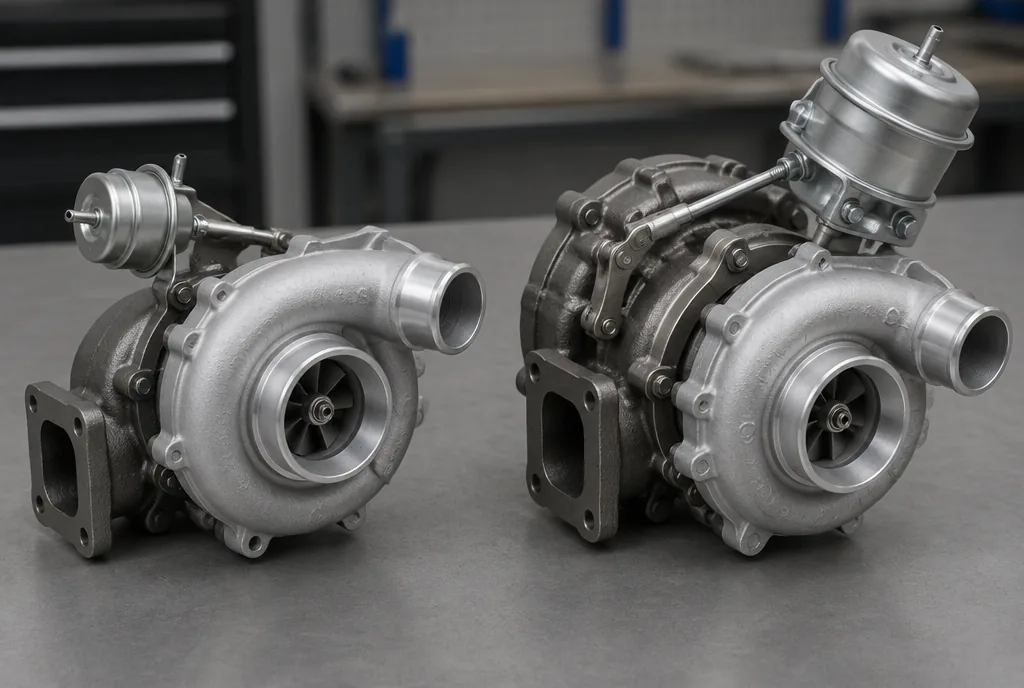
If you are not sure which side of the 2006 line your vehicle sits on, our Gen 3 versus Gen 4 comparison sorts that out, and the turbo itself carries a stamped tag that settles it beyond doubt.
Why the vanes seize
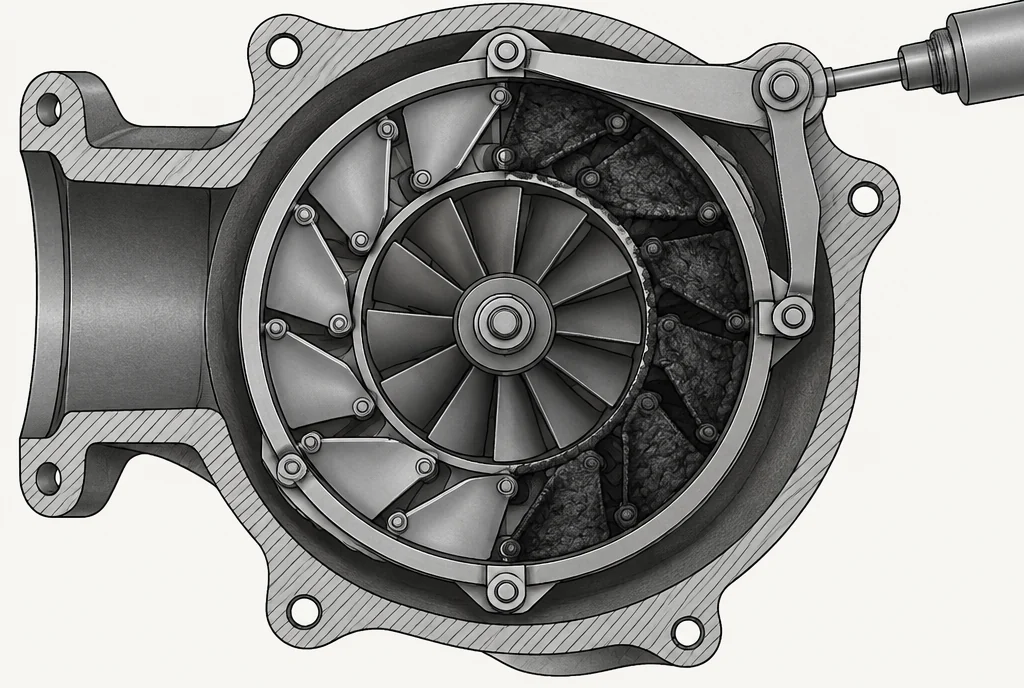
A variable-geometry turbo works by changing the angle of a ring of small vanes in the exhaust housing. Close them down and exhaust gas is forced through a smaller gap, so it speeds up and spins the turbine hard at low revs. Open them out and the turbo flows freely at the top end. That is how one turbo delivers both low-down response and high-end power, and it is why the Gen 4 pulls the way it does from 1,800 rpm.
Those vanes live in the exhaust stream. Exhaust carries soot. Over enough heat cycles the soot packs into the clearances the vanes need in order to swing, and they begin to stick, then bind, then stop moving altogether.
What accelerates it is exactly what you would expect, and it is the same list that carbonises the inlet: short trips, extended idling, and a clogged EGR system. A Pajero doing school runs and traffic is loading the exhaust with soot and never getting hot enough for long enough to keep the mechanism free. A Pajero that regularly works is largely self-cleaning.
This is the practical reason the EGR job and the turbo job belong in the same conversation. Cleaning an inlet manifold while leaving a turbo full of soot, or the reverse, treats half a problem.
Symptoms, by how bad it has got
Turbo trouble announces itself in stages, and the stage you catch it at decides the bill.
Early: the stage worth catching
- Slight lag off idle that was not there before.
- Occasional overboost or underboost codes, often clearing by themselves.
An intermittent boost code on an otherwise healthy Gen 4 is the single most valuable warning you will get. It usually means the vanes are beginning to stick and the ECU is seeing a boost figure it did not ask for. Act here and you are looking at a clean and an actuator check.
Moderate: the turbo is now damaging itself
- A whistle or siren-like noise under load, rising with boost.
- Blue or grey smoke, and oil consumption climbing with no visible leak. That is the shaft seals going.
Severe: stop driving it
- Grinding or metal-on-metal noise, meaning bearing failure or shaft play.
- Complete loss of boost and limp mode, meaning a seized VNT mechanism or a destroyed wheel.
Once a turbo is shedding metal it is feeding that metal into the engine. The difference between the moderate and severe rows is roughly the difference between a turbo and a turbo plus whatever the debris reached.
Be honest with yourself about the first list, though. Soft throttle response and a bit of smoke also describe a carbonised inlet and worn injectors, and all three are common on a high-kilometre 4M41. The symptom does not name the part. Diagnosis does.
The actuator, and why it is the most overlooked repair
The vanes do not move themselves. A vacuum-operated actuator swings them, taking its signal from the ECU through a solenoid. When the actuator is weak, leaking or out of adjustment, the vanes do not reach the positions the ECU is commanding, and the engine behaves exactly as though the turbo has failed.
Turbo specialists describe the actuator as the most overlooked repair on this kind of unit, and recommend checking it before condemning the turbo. It is a fraction of the price. Two things matter if one is replaced:
- Match the part number and the spring rate to the specific turbo casting. Actuators that bolt on are not automatically correct. The spring rate sets how the vanes respond to a given vacuum, so the wrong one gives wrong boost with no fault anywhere else.
- Set the rod length and preload to specification. This is a measured adjustment, not an eyeballed one.
Also check the plumbing before the actuator itself. A perished vacuum hose or a tired solenoid produces the same symptoms for the price of a hose.
Diagnosis, before you spend anything
- Scan it, and watch live boost against commanded boost under load. Stored codes are a start; the live comparison is what separates a vane problem from a fuelling problem.
- Check the vacuum supply and the solenoid before anything is unbolted.
- Inspect the actuator rod for free travel. A rod that moves stiffly, partially, or not at all is telling you about the vanes it is connected to.
- Pull the intake pipe and look for oil. Oil in the intake tract or pooled in the intercooler means shaft seals.
- Check shaft play by hand with the intake off. Some axial movement is normal; a wheel that touches the housing is not.
A workshop that quotes a replacement turbo off a boost code alone, without doing the above, has not diagnosed the car. Our guide to finding a Pajero specialist covers what to ask before you commit.
If the turbo has actually failed, the turbo is not the whole job
This is the part that gets cut to save money and is the reason replacement turbos fail twice. When a turbo dies, it contaminates everything connected to it.
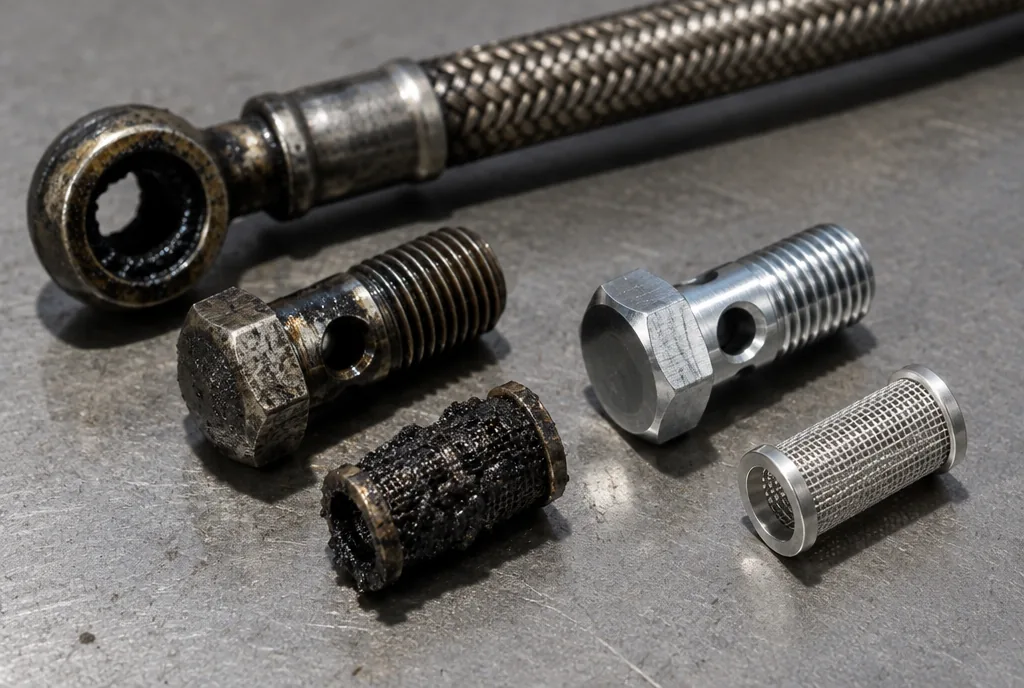
- Replace the oil feed and drain lines. Not clean, replace. The feed banjo carries a small screen that clogs with carbon, and a restricted feed starves the new bearing exactly the way it starved the old one. Fitting a new turbo to the line that killed the last one is a common and expensive mistake.
- Prime the oil feed before first start. A dry start on a new cartridge does real damage in seconds.
- Change the oil and filter. Debris from the failed unit is in the sump.
- Clean or replace the intercooler and its piping, and the EGR plumbing. A failing turbo pumps oil into the intake tract, where it pools. That oil then gets drawn into the engine after the repair. An engine that can feed on its own oil supply does not stop when you turn the key off, which is the reason this step is not optional.
Part numbers, and the one that will mislead you
As with the injectors, the numbers in circulation do not agree, and one of them is for a different engine entirely.
| Number | What sellers attach to it |
|---|---|
| 1515A026 | RHV5, VT12, also listed as VAD30012 / VED30012. Pajero 3.2 DI-D, commonly given as 2006 to 2009. |
| 1515A163 | RHV5S, VT13, 4M41 Euro 4. |
| 1515A029 | Not a 4M41 part. Sellers tie it to an RHF4 (VT10) on the 2.5 litre 4D56 Triton. |
| 1515A170 / VT16 | Appears against “4M41” in some listings, but the stated application is a 2.5 Pajero Sport or L200. Treat as unmatched. |
Every one of those comes from a retailer listing rather than from Mitsubishi or IHI, and the VT-code mapping varies between sellers. The reliable answer is the same as it is for injectors: read the number stamped on the turbo’s own tag, or have it looked up against your VIN. Do not order from a year range, and particularly do not order 1515A029 because it appeared in a search for “Pajero turbo”.
What it costs in South Africa
We could not find a published rand figure for a 4M41 turbo recon or replacement, and we are not going to convert an overseas price and present it as local. What we can give you is the shape of the decision.
From cheapest to dearest, the options run: actuator only, then a core rebuild, then a reconditioned exchange unit, then a new genuine turbo. The gaps between those tiers are large, which is the entire argument for diagnosing properly before buying.
Our own Pajero parts guide puts reconditioned turbos at roughly 30 to 50 percent of the new dealer price, and names Turbo Exchange and Capital Turbos as local specialists worth quoting. For scale on what else sits in this price range, used 4M41 engines were listed between about R39,500 and R44,460 in October 2026.
Two cost notes that are easy to miss. The Gen 4’s variable-geometry unit is dearer to recondition than the Gen 3’s fixed turbo, so the generation split costs money as well as changing the failure mode. And the oil lines, gaskets and an oil change are real money on top of the turbo itself, so a quote that covers only the turbo is not the job described above.
If you have had 4M41 turbo work done here, send us the invoice and we will publish real figures with the month and the workshop.
The cool-down question, and a claim of ours that needs checking
Every Pajero owner has been told to idle the engine before switching off. It is worth being straight about how well that advice is actually supported, because we have repeated it ourselves.
The logic is sound as far as it goes. A turbo that has been working hard is extremely hot. Shut the engine down and oil flow stops while the heat remains, so oil sitting in the bearing housing can bake into a varnish that eventually restricts the oil supply. That is coking, and it is a genuine mechanism.
The argument against is that it applies mainly to turbos cooled by oil alone. A water-cooled bearing housing keeps taking heat out after shutdown, by passive circulation, which is why a lot of modern turbo cars are shut down straight off a motorway with no ill effect.
So which is the 4M41’s? Our own common problems guide says the turbo is oil-cooled and oil-lubricated. Several parts suppliers list the RHV5 for this engine as oil and water cooled. Those cannot both be right, and we are not able to settle it from the sources we have: the supplier listings are retailers rather than IHI or Mitsubishi documentation, and we have not had a factory service manual or a turbo in front of us to check the port layout. We are flagging it here rather than quietly picking the answer we prefer, and we will correct whichever of our pages is wrong once somebody can confirm it from the hardware. If you have an RHV5 off a 4M41 on a bench, we would like to hear what ports it has.
Here is why it does not need to hold up your decision. Nobody in this debate, on either side, produces bearing-failure data, manufacturer test results or a technical bulletin. It is all reasoning and anecdote. Meanwhile a thirty-second idle after hard work costs you nothing and is a sensible habit on either kind of turbo, and the thing everyone does agree on is that it matters most immediately after heavy load. Tow up a pass, pull into the viewpoint, let it run while you take the photograph. After a gentle run to the shops it is academic.
Keeping it alive
- Oil changes on schedule, correct specification, no exceptions. This is the whole game. Degraded oil is the documented primary cause of turbo failure on this engine, and the turbo is the component least forgiving of a stretched interval. Intervals and the correct oil are in our maintenance schedule.
- Give it a proper run regularly. The same habit that keeps the inlet clean keeps the vanes free. Heat and sustained load are the cleaning mechanism.
- Do not idle it for long periods, warming up included. Idling makes soot and does not make heat.
- Drive gently until it is warm. Cold oil is thick and slow to reach the bearing, and the turbo starts spinning the moment you start the engine.
- Keep the EGR and inlet in order. Soot you prevent upstream is soot that never reaches the vanes.
- Investigate an intermittent boost code immediately, while it is still a clean rather than a turbo.
- Be careful what you ask of a remap. Our 4M41 engine guide is specific: much beyond 20 kW over stock without addressing the injection system pushes the hardware past what it was designed for.
The bottom line
Turbo failure on the 4M41 is real but it is not common, and the parent guide is right to call it documented rather than universal. Where it happens, the cause is usually traceable: oil that was old, wrong or slow to arrive, or soot that was allowed to accumulate for years.
What should change how you treat it is the order of the suspects. On a Gen 4, think vanes and actuator before bearings, and think diagnosis before parts. The expensive version of this repair and the cheap version start with identical symptoms, and the only thing standing between them is whether somebody looked properly.
Frequently Asked Questions
What is the most common turbo failure on the Pajero 3.2 DI-D?
On the Gen 4’s variable-geometry turbo it is the vanes seizing with carbon, not the bearing. Soot packs into the clearances the vanes need to swing, and they stick, bind, then stop. Short trips, extended idling and a clogged EGR system all accelerate it. Caught early it is a clean and an actuator check rather than a replacement turbo.
Does the Gen 3 Pajero have the same turbo problem?
No. The Gen 3 and the Triton and L200 use a fixed-geometry turbo of the TF035 or TD03 class with a wastegate, and a fixed turbo has no vanes to seize. Gen 3 owners are looking at bearings, shaft seals and the oil supply instead. The two turbo types are not interchangeable and their actuator hardware differs.
What are the symptoms of a failing Pajero turbo?
In stages. Early: slight lag off idle and intermittent overboost or underboost codes. Moderate: a whistle or siren noise under load, with blue or grey smoke and rising oil consumption as the shaft seals go. Severe: grinding or metal-on-metal noise, or complete loss of boost and limp mode. The early symptoms also describe a carbonised inlet or worn injectors, so diagnose rather than assume.
Should I replace the turbo or just the actuator?
Check the actuator first. Turbo specialists call it the most overlooked repair on these units, and it costs a fraction of a turbo. A weak, leaking or misadjusted actuator stops the vanes reaching the commanded positions and makes a healthy turbo behave like a failed one. If one is fitted, match the part number and spring rate to the specific turbo casting and set the rod length and preload to specification.
What else must be replaced when a Pajero turbo is changed?
The oil feed and drain lines, because the feed banjo screen clogs with carbon and a restricted feed will starve the new bearing the same way it starved the old one. Prime the oil feed before first start, change the oil and filter since debris is in the sump, and clean or replace the intercooler piping and EGR plumbing, because oil pooled there gets drawn into the engine after the repair.
What is the turbo part number for the Pajero 4M41?
Sellers most consistently list 1515A026 (RHV5, VT12, also VAD30012 and VED30012) for the 2006 to 2009 Pajero 3.2 DI-D, and 1515A163 (RHV5S, VT13) for the Euro 4 4M41. Be careful with 1515A029, which sellers tie to an RHF4 on the 2.5 litre 4D56 Triton and is not a 4M41 part. These are retailer listings rather than Mitsubishi or IHI data, so read the number stamped on your own turbo tag before ordering.
Do I need to let a Pajero idle before switching it off?
After hard work, yes, and it costs nothing. Oil left in a very hot bearing housing with no flow can coke into a varnish that restricts the oil supply. How much this matters depends on whether the housing is water-cooled as well as oil-cooled, and sources conflict on the 4M41, so we are not stating it as settled. Nobody on either side of that argument offers failure data. A thirty-second idle after towing or a long climb is sensible on any turbo; after a gentle run it is academic.
Sources
- PT Turbo: Mitsubishi 4M41 3.2L turbocharger guide, fixed versus variable geometry, failure modes by severity, actuator and oil-line practice
- Turbo Pros: genuine RHV5 for the Pajero 4M41, part 1515A026, VT12
- Denco Diesel: RHV5S turbocharger 1515A163, VT13, 4M41 common rail
- Wikipedia: Mitsubishi 4M4 engine family, including the IHI RHV5 variable-geometry fitment
- 4×4 Community: EGR, soot and the turbo consequences of a valve stuck closed