
Your 4M41 is sooting up its own inlet manifold right now, and it is doing it on purpose. That is not a fault. It is the emissions system working exactly as Mitsubishi designed it. The fault only arrives later, when enough of that soot has collected to start choking the engine that produced it.
Inlet carbonisation is the most universal problem on the 3.2 DI-D. Timing chain guides wear on some engines. Turbos fail on some engines. Every single 4M41 carbonises. The only variable is how fast, and that is decided almost entirely by how the vehicle is driven.
It appears as a single paragraph in our 3.2 DI-D common problems guide. It deserves more than that, because unlike most of the entries on that list it is not a question of whether yours will do it.
What the EGR is for, and why it makes a mess
Exhaust Gas Recirculation does one job. It takes a measured amount of spent exhaust gas and feeds it back into the inlet, so that some of the air going into the cylinder is inert. Less oxygen and a lower peak flame temperature means less oxides of nitrogen out of the tailpipe. NOx forms when combustion gets hot, so cooling combustion is the cheapest way to cut it.
Mitsubishi fitted it because legislation required it, not because it helps the engine. Nothing about recirculating exhaust improves power, economy or longevity. It is a tailpipe measure, and the cost of it is paid inside the inlet tract.
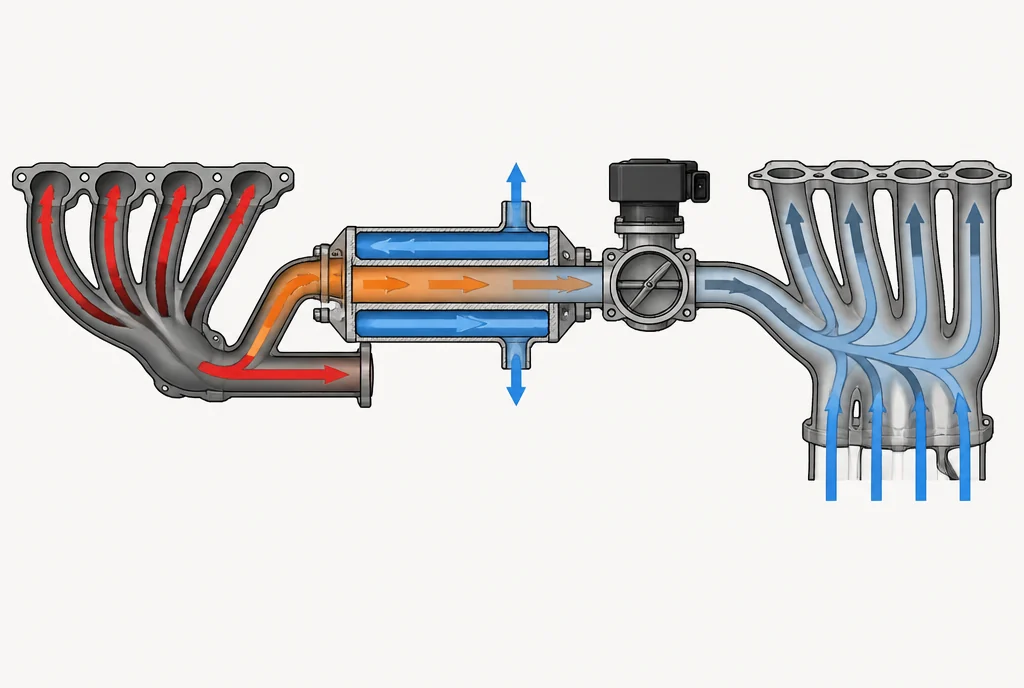
On the Gen 4 the gas is cooled on its way round. Aftermarket suppliers list EGR cooler kits specifically for the NS, NT and NW Pajero from 2006 to 2014, which tells you the circuit runs exhaust through a coolant-jacketed heat exchanger before the valve meters it into the inlet. Cooling the gas makes it denser and more effective at suppressing NOx. It also drops the soot out of suspension sooner.
Soot plus oil mist equals tar
Here is the part that catches people out. If the inlet were collecting dry soot, it would largely blow through. It is not collecting dry soot.
The crankcase ventilation system vents oil-laden vapour into the same inlet tract. That oil mist meets the dry carbon arriving from the EGR, and the two combine into a black, sticky deposit with roughly the consistency of roofing tar. It bonds to the manifold walls, builds in layers, and sets hard. You cannot blow it out, and in a bad case you cannot scrape it out with the manifold on the engine.
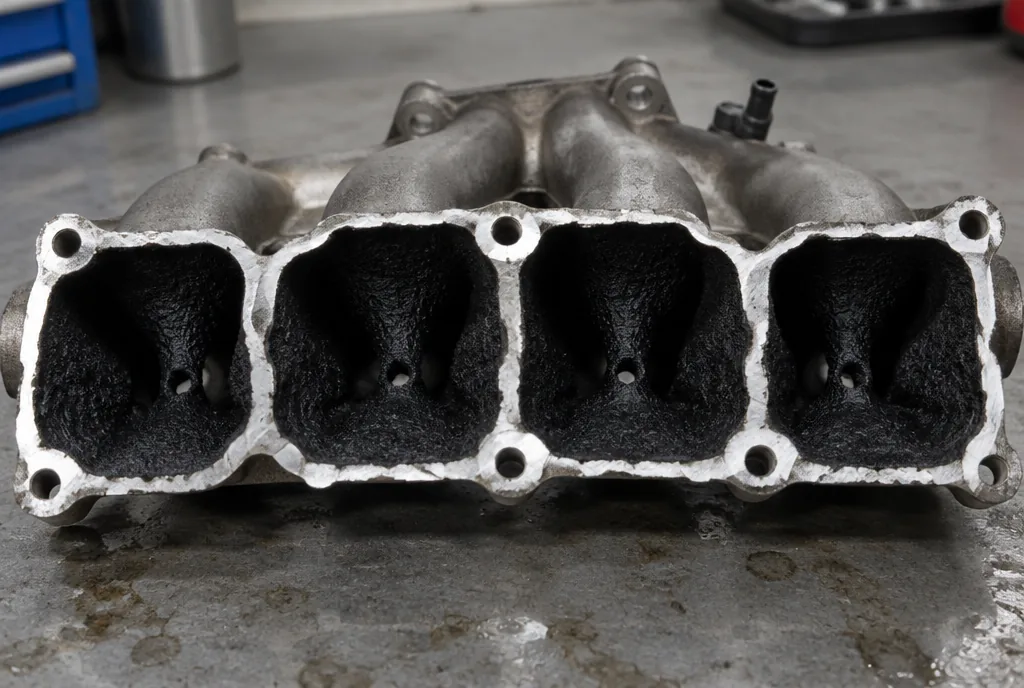
That deposit narrows the runners. A manifold with a 15 mm crust around the inside of every port is flowing a fraction of the air it was designed to flow, and the engine has no way of telling you that directly. It just gets progressively duller while you get progressively used to it.
Why a South African Pajero carbonises faster
The rate depends on duty cycle, and the typical South African Pajero has close to the worst duty cycle available.
EGR operates most heavily at light load and low engine speed. Cruising on the open road at a steady throttle, the system backs off and the inlet runs relatively clean. Crawling along in Johannesburg traffic at 30 km/h in third, or doing a 6 km school run twice a day, the valve is working constantly and the engine never gets hot enough for long enough to burn anything off. A Pajero that tows to the coast twice a year and otherwise does suburb errands is accumulating deposits almost all of the time it is running.
The 4×4 Community forum’s long-running EGR thread puts it plainly: pottering around town at low speeds is especially bad for EGR valves. That matches what workshops see, and it matches the physics.
There is a fuel-quality dimension too, although it needs stating carefully. The International Council on Clean Transportation records that South Africa has not updated its official vehicle emission standard regulations since adopting Euro II in 2006. That is a statement about regulation, not about what comes out of a particular pump, and we are not going to claim a soot figure for South African diesel that we cannot source. What it does mean is that nothing in the local standards framework is pushing fuel or vehicles in the direction that would slow this down.
Symptoms, in the order they turn up
Carbonisation is gradual, which is why it is so often missed. It does not break. It fades.
- Throttle response goes soft. The first sign, and the one almost nobody notices, because it arrives over two years. The engine takes a beat to answer a stab of throttle at low revs.
- Hesitation pulling away. Particularly loaded, uphill, or in the 1,500 to 2,000 rpm band where the engine is relying on EGR-affected airflow.
- Black smoke on acceleration. Not enough air for the fuel being injected, so the surplus leaves unburnt.
- Rough or hunting idle. Uneven restriction across four runners means uneven cylinder filling.
- Fuel consumption creeping up with no change in how or where you drive.
- A check engine light, usually P0401 to P0403 for EGR flow, sometimes P0106.
- Limp mode. The end state. Power cut hard, often with an inability to pull past about 2,000 rpm.
The honest difficulty with the first five is that they describe a tired diesel in general. Worn injectors do most of this too. So does a turbo with sticking vanes, which is itself frequently caused by the same soot. Diagnosis matters here more than on most faults, because the symptom list is not distinctive.
The fault code that sends workshops the wrong way
P0106 is a manifold absolute pressure sensor range and performance code. Read literally it says the MAP sensor is lying, and the obvious response is to fit a MAP sensor.
On a carbonised 2007 to 2016 Pajero diesel the sensor is usually innocent. The MAP sensor reads manifold pressure through a small port or hose, and that passage is a dead-end branch off a tract full of airborne tar. It blocks. The sensor is then reporting a pressure that is real for the inside of a blocked tube and wrong for the manifold, so the ECU flags it.
Clear the port and the code goes. If it comes back, the usual reading is that the manifold itself is heavily caked and needs to come off and be cleaned properly. A recurring P0106 after a port clean is one of the more reliable indicators that you are past the point where chemicals will help.
Be aware of the reverse error as well. One owner’s account of a P2413 on a 4M41 describes a workshop decoking the intake and swirl valve first, with the code returning until the EGR valve itself was replaced. Cleaning the inlet does not fix a valve that has failed electrically, and replacing the valve does not fix a manifold full of tar. The two faults travel together and get mistaken for each other in both directions.
How to check yours
Unlike the crankshaft pulley, you cannot assess this one with a torch at idle. The deposit is inside the casting. But you can get close.
- Scan it, including live data. Stored codes are the start. Watching MAP against expected boost while the engine is loaded tells you considerably more than a code list.
- Pull the intake ducting at the manifold inlet. You are looking at the first few centimetres of the tract. If there is a soft black crust you can dent with a fingernail, the runners behind it are worse, because flow slows and deposition increases further in.
- Check the EGR valve for free movement. A valve that is sticking is both a cause and a consequence.
- Inspect the MAP port and hose before anyone sells you a sensor.
- Borescope the runners if the workshop has one. This is the only way to actually see the scale of it without removing the manifold, and it turns an argument about whether the job is needed into a picture.
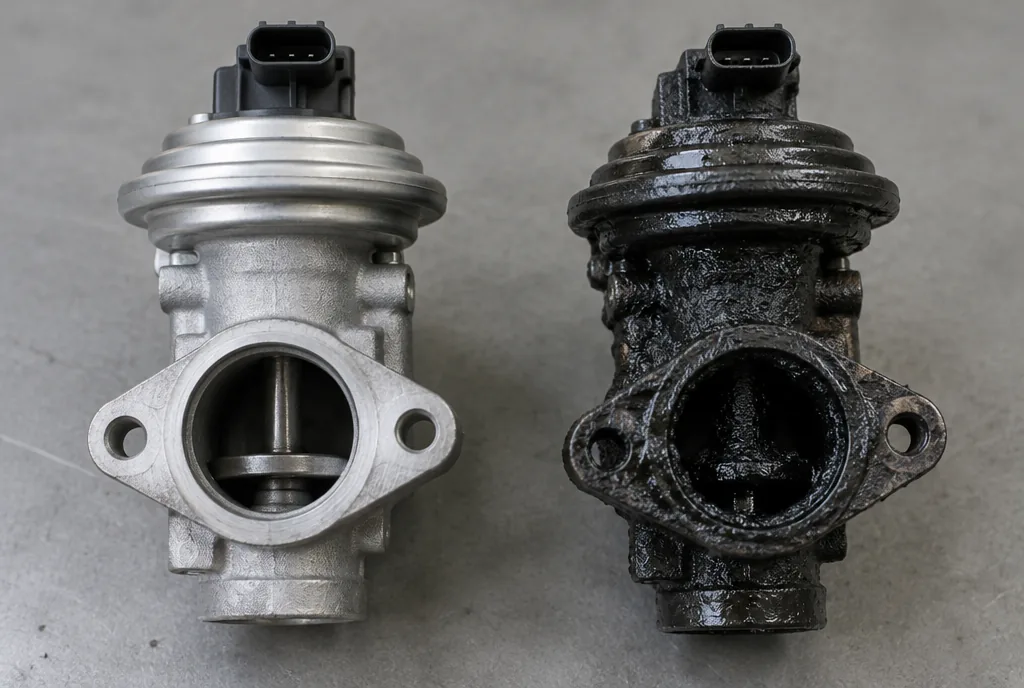
On a high-kilometre 3.2 DI-D with an unknown service history, assume it is carbonised and inspect to find out how badly. That is the right default, and it belongs in your pre-purchase checks alongside the cold-start listen.
What the clean actually involves
There are three tiers, and they are not interchangeable.
Chemical, in service
An induction cleaner fed into the inlet with the engine running, or a fuel-system additive. Cheap, quick, and genuinely useful as prevention on an engine that is not yet badly loaded. It will not shift a hardened crust, and selling it as a fix for one is where a lot of money gets wasted.
Hydrogen carbon clean
Available from several South African operators, including specialists in Cape Town and the Overberg. Hydrogen is introduced into the intake and burned, with the claim that the resulting combustion lifts deposits. One SA provider quotes about 45 minutes for the process. It is non-invasive and inexpensive relative to a strip. Independent evidence for how much hardened deposit it removes from a diesel inlet manifold is thin, and we are not in a position to verify the claims made for it. Treat it as somewhere between prevention and a genuine clean, and ask for before-and-after borescope images.
Manifold off, cleaned on the bench
The only method that is certain. The inlet manifold comes off the engine, gets stripped of deposits mechanically or by media blasting, and goes back with new gaskets. The EGR valve and cooler are cleaned or replaced at the same time, because refitting a clean manifold to a dirty EGR circuit is throwing the labour away.
A Cape Town specialist describes doing the equivalent job without major engine stripping, removing the intake manifold to reach the valve stems. On the 4M41 the manifold is accessible, so this is a labour job rather than an engine-out job. Walnut shell blasting is the method most associated with it, although note that most walnut-blasting literature is written about petrol direct-injection engines, so confirm with the workshop that they do it on common-rail diesels and what they use.
What it costs
We cannot give you a verified South African price for this job, and we are not going to invent one. No local carbon-cleaning specialist we could find publishes a rate, and the quotes are given after a scan. If you have had a 4M41 inlet cleaned here, send us the invoice and we will publish the real numbers with the month and the workshop.
What we can give you is the parts side and some foreign benchmarks, clearly labelled as foreign.
| Item | Indicative figure | Source and caveat |
|---|---|---|
| EGR valve, aftermarket | from about £100 | Marketplace listing, October 2026. Chinese-made unit. |
| EGR valve, branded | about €248 | German parts shop, October 2026. |
| EGR valve, Australian retail | AU$600 to AU$850 | Two marketplace listings, October 2026. |
| Workshop carbon clean | AU$600 to AU$900 | Australian mechanic’s published range. Not a South African price. |
| Workshop carbon clean | US$700 to US$1,200 | US commercial guide, petrol-focused. Not a South African price. |
Do not convert those into rands and treat the result as a quote. Labour rates, parts import duties and what a local workshop includes in the job all differ. They are there to tell you the order of magnitude, which is hundreds of rands for a chemical treatment and several thousand for a manifold-off clean.
On part numbers
The EGR valve most commonly referenced for the 4M41 is 1582A037, with a five-pin connector, listed against NS, NT, NW and NX Pajeros from 2006 to 2019. Numbers that come up as alternatives or supersessions include 1582A038, 1582A483, K5T70080 and K5T70081.
Every one of those references comes from a seller listing rather than from Mitsubishi’s own fitment data, and sellers group these numbers loosely. Confirm against your VIN at a dealer parts counter before you order, and check the plug on your existing valve. Genuine valves are also listed as covering NM and NP, so Gen 3 owners are in the same conversation.
Blanking: where South African owners genuinely disagree
Ask whether to blank the EGR and you will get a confident answer either way. Both camps contain experienced people, and the honest position is that this is unsettled.
The 4×4 Community thread is a good window on it, because the disagreement is between South African owners talking about these engines.
One member reported that a Mitsubishi specialist had seen 3.2 engines burning holes in pistons after EGR blanking. Another answered that his Gen 3 Pajero had run about 60,000 km with a blocked EGR and was purring like a kitten, and that the piston damage was caused by faulty injector spray rather than by the blanking. A third said a Pajero might have problems blanked, while his Navara 2.5 dCi showed no temperature increase at all.
The thread’s author started out recommending cleaning and servicing the valve rather than blanking it, and later mentioned having a blank plate at home ready to fit. That is a fair summary of where most owners land: they know what the careful answer is, and the temptation is strong.
The mechanism behind the overheating argument is real enough in principle. Remove EGR and peak combustion temperature rises, because that was the entire point of the system. Whether the rise on a 4M41 is enough to damage pistons, and under what load, is the part nobody in that thread could actually demonstrate. It is worth noting that a vehicle with a blanked EGR and a fault elsewhere, injectors for instance, gives you two plausible explanations for one holed piston, and that is exactly the argument those owners were having.
Our view, stated as a view: blanking treats the symptom by disabling the system, and it does so on an engine where the consequences are disputed by people who work on them. Cleaning treats the cause and leaves the vehicle as designed. If you have a sound reason to go the other way, go in knowing the argument is unresolved rather than believing it is settled.
Is blanking legal in South Africa?
We looked for a clear answer and did not find one. Here is what we can and cannot establish.
The National Road Traffic Act 93 of 1996 provides that no person shall without lawful excuse tamper with a vehicle or with any part of the equipment or the accessories of any vehicle. Disabling an emissions control device arguably falls inside that wording. We could find no South African court ruling, and no official guidance, applying that provision to EGR removal specifically.
Roadworthy practice is inconsistent. Some sources say no emissions testing happens at a roadworthy test beyond an examiner observing the exhaust for black smoke. Others describe stations running a visual smoke check or an opacity test on acceleration for diesels. A vehicle that smokes visibly is at risk either way.
One point of caution on sourcing. At least one South African supplier’s page arguing that removal is not illegal in itself cites the “Road vehicles (Construction and Use) Regulations”, which is the title of United Kingdom legislation. We could not confirm a South African regulation by that name. A commercial page citing another country’s law as though it were ours is not a basis for a decision.
So: real risk under the tampering and emissions provisions, no authority we can point to that settles it, and inconsistent enforcement. This is not legal advice, and if it matters to you, ask an accredited testing station or a motor-law attorney rather than a forum or a supplier.
Keeping it from coming back
A cleaned manifold starts carbonising again the moment you drive away. The job is to slow it down.
- Give it a proper run regularly. One Mitsubishi specialist’s guidance for keeping a diesel’s emissions hardware healthy is a steady half-hour run weekly, or an hour fortnightly. A sustained load at open-road speed does more good than any bottle.
- Stop idling it to warm up. Extended idling is close to the worst thing you can do. Start it, give it thirty seconds, and drive gently until it is warm.
- Keep oil changes short. Degraded oil means more blow-by, and more oil mist in the inlet is half of what makes the tar. Our maintenance schedule has the intervals and the correct specification.
- Fix oil leaks and breather problems promptly, for the same reason.
- Clean the valve on a schedule rather than waiting for a code, if the vehicle lives in traffic.
If your Pajero genuinely is a town car, read our piece on running a Pajero as a daily driver, because this is one of several costs that come with that use case and they are worth counting together.
The bottom line
This is a maintenance item that the service schedule does not mention, on a system fitted to satisfy regulators rather than to help the engine. It is not a reason to avoid the 3.2 DI-D. The 4M41 is one of the most durable four-cylinder diesels ever fitted to a 4WD, and a carbonised inlet is a day’s labour, not a new engine.
What it is, is a reason to stop assuming that a gradually duller Pajero is just an older Pajero. Most owners of high-kilometre 3.2s have never had the inlet looked at, and a good proportion of them are driving around with a manifold they would be startled to see the inside of.
Frequently Asked Questions
Does every Pajero 3.2 DI-D get carbon build-up?
Yes. Recirculating exhaust into the inlet deposits carbon by design, and crankcase oil mist turns that carbon into a sticky deposit. Every 4M41 does it. What varies is the rate, which is driven mainly by how the vehicle is used. Short urban trips accelerate it dramatically; regular open-road running slows it down.
What are the symptoms of a blocked EGR on a Pajero?
Soft throttle response at low revs, hesitation pulling away under load, black smoke on acceleration, a rough or hunting idle, fuel consumption creeping up, and eventually a check engine light with EGR flow codes P0401 to P0403 or a P0106. Severe cases go into limp mode and will not pull past about 2,000 rpm. The early symptoms arrive slowly enough that most owners adapt to them without noticing.
Why does my Pajero keep throwing a P0106 code?
On a carbonised 2007 to 2016 Pajero diesel, P0106 is usually not a failed MAP sensor. The sensor reads manifold pressure through a small port that blocks with the same oily soot filling the manifold. Clean the port and hose first. If the code returns after that, the manifold itself is likely heavily caked and needs removing and cleaning properly.
Should I blank the EGR on my Pajero?
South African owners genuinely disagree, and we are not going to pretend otherwise. One camp reports 3.2 engines holing pistons after blanking; the other reports tens of thousands of kilometres blanked with no trouble and blames piston damage on injectors. Blanking raises peak combustion temperature by definition, because suppressing it was the system’s purpose. Our view is that cleaning treats the cause and blanking disables the system, with legal questions attached in South Africa that nobody has settled.
Is an EGR delete legal in South Africa?
Unclear. The National Road Traffic Act 93 of 1996 prohibits tampering without lawful excuse with a vehicle or any part of its equipment, which arguably covers disabling an emissions device, but we found no South African ruling or official guidance applying it to EGR removal. Roadworthy testing practice varies between stations, and a diesel that smokes visibly is at risk regardless. This is not legal advice.
What does it cost to clean a Pajero inlet manifold in South Africa?
We could not find a South African workshop that publishes a rate, and we will not invent one. Quotes here are given after a diagnostic scan. For scale, Australian workshops publish roughly AU$600 to AU$900 for a carbon clean, and an aftermarket EGR valve starts around £100 with branded units nearer €248. Expect hundreds of rands for a chemical treatment and several thousand for a manifold-off clean. If you have a real local invoice, send it to us and we will publish the figure.
What is the EGR valve part number for the 3.2 DI-D?
1582A037 is the number most commonly referenced for the 4M41, with a five-pin connector, covering NS, NT, NW and NX models from 2006 to 2019. Alternatives and supersessions include 1582A038, 1582A483, K5T70080 and K5T70081. These come from seller listings rather than Mitsubishi fitment data, so confirm against your VIN at a dealer parts counter before ordering.
Sources
- 4×4 Community: EGR explained, and the South African owner debate on blanking
- Go-Parts: P0106 on 2007 to 2016 Mitsubishi Pajero diesel, MAP sensor and carbon build-up
- Expert Carbon Cleaning: Mitsubishi EGR and intake symptoms, codes P0401 to P0403, and the weekly run guidance
- Racingtechnik, Cape Town: walnut blasting with the inlet manifold removed
- Carbon Doctor SA: walnut blasting carbon cleaning in South Africa
- Machter: EGR valve 1582A483 fitment, Pajero NS to NX and Triton ML
- Metav Parts: EGR cooler kit, Pajero NS NT NW 2006 to 2014
- SAFLII: National Road Traffic Act 93 of 1996
- ICCT: South Africa’s vehicle emission standards, unchanged since Euro II in 2006
- Consumer Reports: what walnut blasting is, and typical cost
- Craig Jones Auto: Australian workshop and DIY carbon cleaning costs