Two completely different things happen to Pajero injectors, and almost every conversation about them muddles the two together.
The first is wear. Injectors are precision devices metering fuel at well over a thousand bar, and after 200,000 km they are not what they were. That one arrives slowly and you can plan for it.
The second has nothing to do with wear at all. A copper washer the size of a coin fails, combustion gas starts escaping past the injector into the engine bay, and the resulting mess welds the injector into the cylinder head. That one is a sealing failure, it can happen at any mileage, and left alone it turns a washer job into head work.
Our 3.2 DI-D common problems guide covers the first as a high-mileage item. This article covers both, because the second is the one that catches people out.
Black death, and why it is a sealing problem
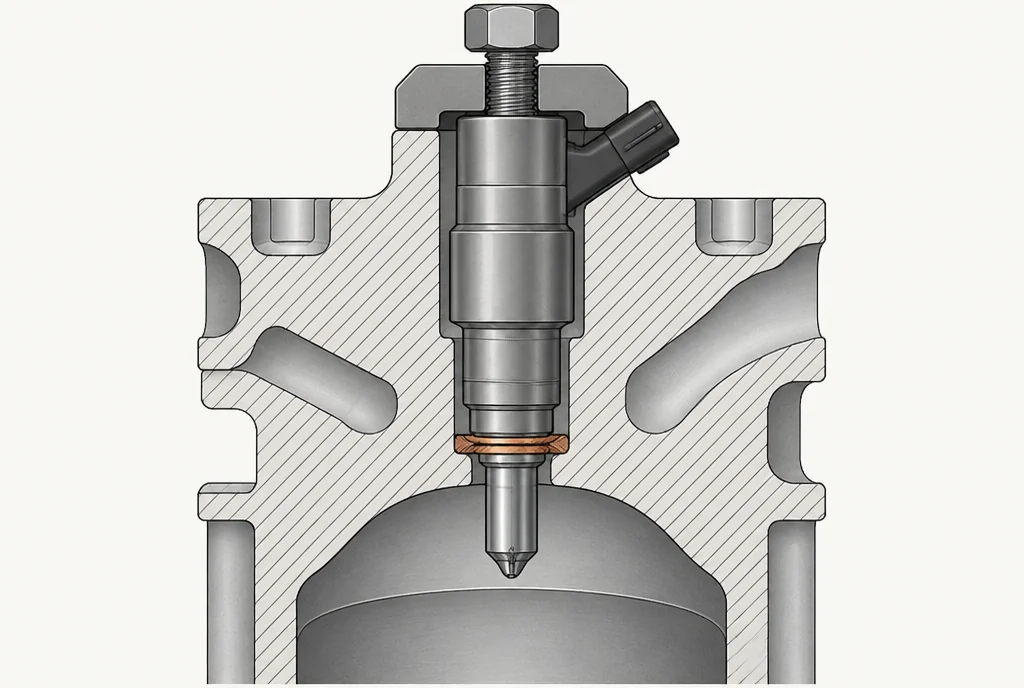
Each injector sits in a bore in the cylinder head with its nozzle poking into the combustion chamber. Sealing that joint is a soft copper washer, crushed between the injector nose and its seat in the head when the clamp is torqued down. That washer is the only thing standing between combustion pressure and the outside world.
When it fails, hot combustion gas blows past it. The gas carries unburnt fuel and picks up oil on the way, and that mixture bakes onto everything around the injector into a hard black tarry crust. The name is unlovely but the description is accurate: it looks like the top of the engine is rotting.
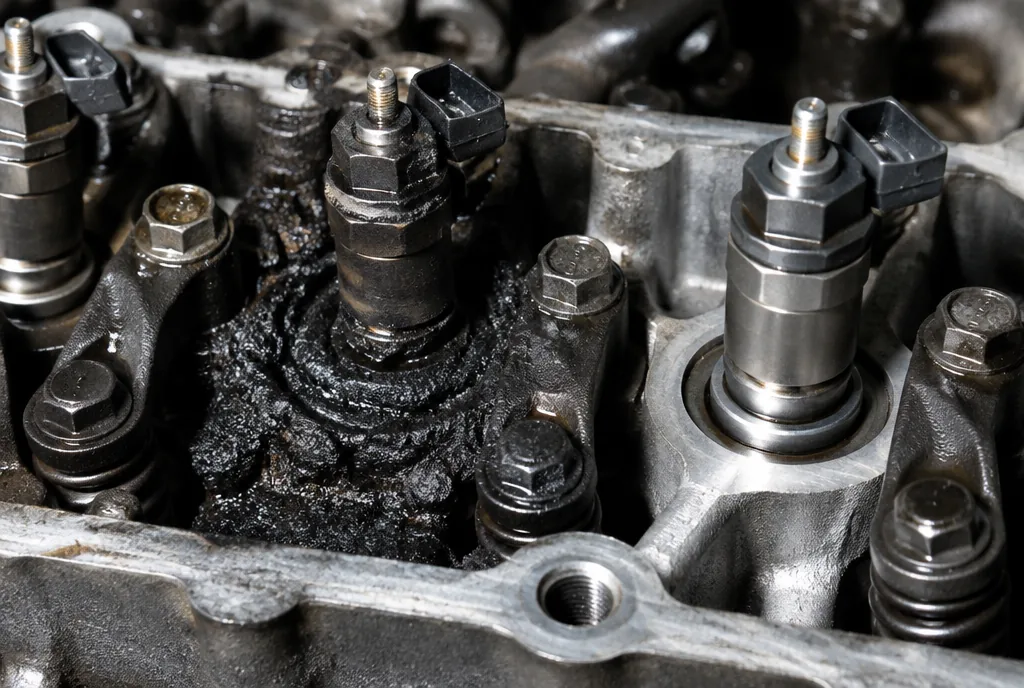
What makes it serious is not the mess. It is that the leak is self-worsening. Escaping gas erodes the seat in the cylinder head, so the sealing surface the washer needs gets progressively worse, so more gas escapes. Meanwhile the carbon packs into the gap between the injector body and the bore, and sets. Catch it in the first few weeks and it is a washer, a clean and a reseat. Catch it a year later and the injector is cemented in place.
What it sounds and smells like
- A chuffing or hissing from the top of the engine, in time with engine speed. This is the single most diagnostic symptom and it usually arrives before anything is visible.
- Diesel or exhaust smell in the cabin, particularly with the vents on fresh air at idle.
- Black crust around the base of one injector. Clean the area, drive it a week, look again. Fresh deposit means an active leak.
- A new tick or rattle that sounds mechanical and is loudest at the affected cylinder.
- Harder starting, in the later stages.
If you hear the chuffing, do not wait for it to get worse to confirm the diagnosis. Waiting is what turns this into an expensive job.
Why they seize, and how to get one out
The injector is steel, the head is aluminium, and the gap between them fills with carbonised fuel and oil residue that hardens over years of heat cycling. The deposit grows, the seal degrades further, and the injector is progressively cemented into its well. On vehicles that see salt there is an argument that galvanic corrosion between the steel body and the aluminium head adds to the bond, although that one is forum reasoning rather than documented fact.
Removal is a known art with a known escalation ladder. It is worth understanding even if someone else is doing the work, because the difference between a workshop that follows it and one that reaches straight for the big hammer is a cylinder head.
- Work on a warm engine. Heat softens the carbon. One approach is to break them loose hot, then let the engine cool before chipping the hardened deposit away.
- Soak it. A fifty-fifty mix of acetone and automatic transmission fluid, left for several hours or overnight, is the long-standing penetrant recipe for dissolving carbon around a stuck injector.
- Rotate before you pull. A quarter turn, no more, on the factory flats of the injector body with a correctly sized spanner. Not vice grips. That small rotation breaks the carbon bond without loading the internals.
- Then pull, gradually. A slide hammer or a hydraulic puller, with steady moderate force increased in steps. Sudden maximum force is how injectors break.
- Stop if it will not move. Forcing a seized injector past this point risks snapping it, and a body or nozzle-tip break generally means the head comes off so the remains can be driven out from the combustion chamber side.
There is one more method that circulates: slacken the clamps and run the engine so compression pops the injector up. It works. It also destroys the injector’s internal seals in the process, so it belongs at the very bottom of the list, on an injector you have already written off.
Two things that must happen on reassembly
New copper washers, every time. Not cleaned, not reused, not flipped over. A crushed washer has already done its one job. Reusing it is the most preventable cause of the same leak coming back, and the part costs almost nothing.
Inspect the seat, and recut it if it is eroded. If gas has been escaping for a while it will have pitted the sealing face in the head. A new washer on a damaged seat leaks again. Seat-cutting tools exist for exactly this, and a workshop that does not own one or will not check is the wrong workshop for this job.
The other failure: wear
Now the slow one. The 4M41 runs Denso common-rail injection, and the injectors are metering fuel in multiple events per cycle at pressures the engine’s designers would have called absurd a generation earlier. They wear.
Wear shows up as poor spray pattern and as internal leakage, where fuel that should have been injected instead returns to the tank. Symptoms are undramatic and easy to put down to age: harder cold starting, a slight misfire or uneven beat at idle, fuel consumption drifting up, and smoke under load once it is well advanced.
The received wisdom in the South African Pajero community, and it is sound, is to treat injectors as a planned item somewhere in the 200,000 to 250,000 km window rather than waiting for a failure. Reconditioning before they fail is cheaper than reconditioning after, and considerably cheaper than what a disintegrating injector can do.
How to find out where yours are
You do not have to guess, and you should not pay to remove four injectors to find out.
The leak-off test
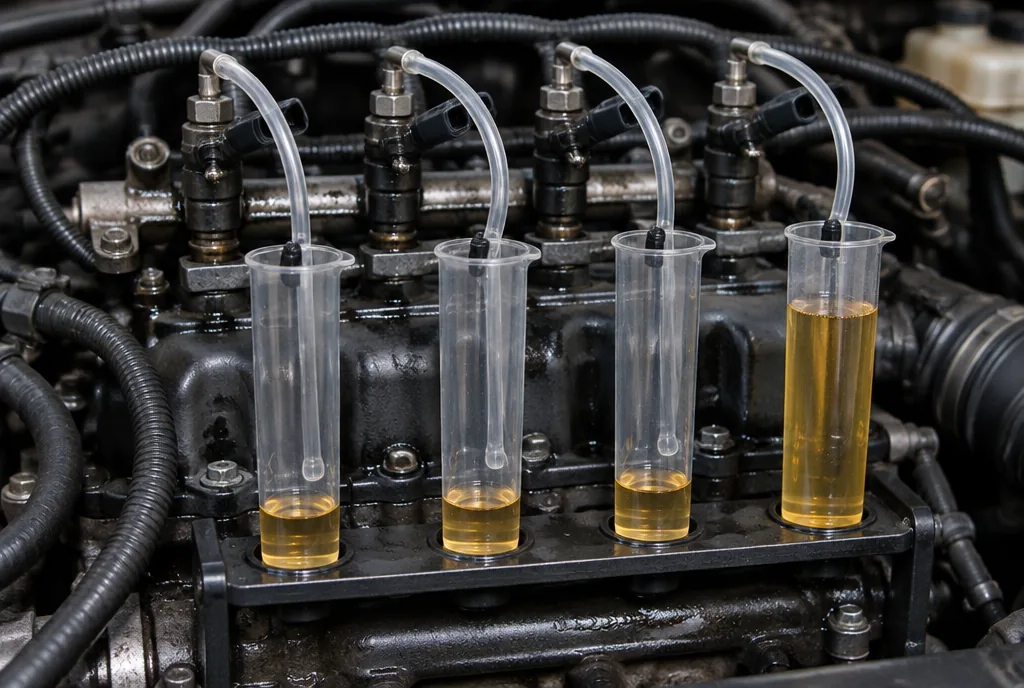
The standard first check on any common-rail engine, and the one that needs no special tooling. The return line from each injector is disconnected and fed into its own measuring container, the engine is run, and the spill volume from each injector is compared.
All four should return roughly the same amount. An injector returning dramatically more than its neighbours is leaking internally, which means fuel intended for the cylinder is going back to the tank. It is a comparative test rather than an absolute one, which is what makes it so useful: you are looking for the odd one out, and the odd one out is usually obvious.
Through the ECU
On a common-rail 4M41 a diagnostic tool can interrogate the injectors without removing anything, which is worth knowing before a workshop quotes you for a strip-down to diagnose. Combine that with a leak-off test and you have a good picture for very little money.
Bench testing
Once they are out, a diesel specialist with common-rail equipment tests spray pattern and delivery against specification. Note the qualifier. Not every diesel workshop can properly test a modern common-rail injector, and forum members have been caught by shops that took the work without the equipment. Ask what they test on before you leave the parts.
One useful consequence of testing: injectors removed during a seal-leak repair frequently do not need replacing at all. An injector only earns replacement if it was damaged coming out or it fails on the bench.
The part number problem
This is messier than it should be, and the sources genuinely contradict each other.
| Source | Says |
|---|---|
| Denso injector catalogue | OE 1465A041 equals Denso 095000-5600, listed under Mitsubishi Triton and Pajero |
| Mitsubishi common rail service document | 1465A041 is for the 4D56. The 4M41 takes 1465A054, Denso 095000-5760 |
| Specialist retailers | 1465A054 for the 3.2 Pajero and Triton; 1465A279, Denso 095000-7500, for the Pajero NT from 09/2008 |
Mitsubishi’s own service documentation ought to outrank an aftermarket catalogue, which points to 1465A054 for the earlier 4M41 and 1465A279 for the later DPF-era cars. But we are not going to tell you a number is correct for your vehicle on that reasoning alone.
The reliable answer is physical. The OE part number is printed on the side of the injector body. Read it off the one you are replacing, and cross-check it against a current Denso catalogue before ordering anything.
Coding, and the step people forget
You cannot bolt in a common-rail injector and drive away. Every Denso injector is individually calibrated at manufacture, and its characteristics are engraved on the injector head as a QR code and as a thirty-character alphanumeric ID. The ECU needs that ID to know how to drive that specific injector in that specific cylinder.
Mitsubishi’s procedure is to enter the ID codes into the engine ECU with the MUT-III diagnostic tool whenever an injector is newly installed. Practically, that means writing down each injector’s code against the cylinder it is going into before you start, then entering each code to the matching cylinder afterwards. If the tool rejects a code, the usual cause is the wrong vehicle, production date or ECU manufacturer selected in the software rather than a bad code.
Here is the part that gets skipped. On the 4M41 in the Pajero and Triton, coding alone is not sufficient. An injection pilot relearn has to be performed as well, with a scan tool, after the injectors are coded and fitted. Then the vehicle wants a decent day of varied running so the new injectors settle in.
If a Pajero has had injectors fitted and runs roughly or unevenly afterwards, an omitted pilot relearn is a strong candidate before anyone starts blaming the parts.
The pump, and the thing that mimics injectors
The 4M41 runs a Denso HP3 high-pressure pump. Before condemning injectors, rule the pump out, because the overlap in symptoms is substantial and the usual suspect is not the expensive part.
The most frequent fault on an HP3 is the suction control valve, the solenoid that regulates how much fuel the pump pressurises. A faulty SCV produces hard starting, fluctuating rail pressure, rail pressure codes in the P0087 and P0088 family, and limp mode. All of that reads as injector trouble to an owner, and the SCV is a fraction of the price of a set of injectors. Fuel contamination and plunger and barrel wear follow it on the list.
Then there is the failure everyone has heard about, which deserves to be described carefully rather than dramatically. When a high-pressure pump fails catastrophically its internals shed metal, and that metal travels downstream through the rail and into the injectors. The cleanup is not a pump: it is the pump, the rail, the injectors, the lines and the filter, and if the tank cannot be properly cleaned it may be the tank too. Missing one particle restarts the whole cycle.
An honest caveat on that. The detailed documented accounts of debris cascading through an entire fuel system are mostly written about the Bosch CP4 pump, not the Denso HP3, and we could not find a Denso or Mitsubishi bulletin describing it for the HP3 specifically. The mechanism is general to high-pressure pumps and the principle holds. The frequency on this particular pump is not something we can put a number on, and anyone who gives you one is guessing.
What is worth doing is cheap: when the fuel filter is changed, cut the old one open and look for metal. Glitter in a filter is early warning, and it is free to check.
What it costs in South Africa
Unlike the inlet-cleaning job, there are real local numbers here. Most are old, so every figure below carries its vintage. Treat the forum material as historic and the current listing as current.
| Job | Figure | Source and vintage |
|---|---|---|
| Recondition one 4M41 injector | R2,250 each | Current classified listing, October 2026. Quoted per injector with a six-month guarantee. |
| Four injectors plus fitting | R5,947 total | Owner’s reported invoice, R4,561 parts and R1,386 labour. Historic forum post. |
| Injector service | R2,200 excl VAT | Historic forum post. Replacement parts extra. |
| New injector, dealer | R2,789 each | Historic Mitsubishi quote reported by an owner. |
| New injector, specialist | R3,412 each | Historic quote reported by an owner. |
| Remove, check and service | about R300 | Historic forum post. Diagnostic only. |
Two things to read out of that table. The first is that reconditioning has consistently come in well under replacement, which is why the local advice has settled on rebuilding rather than buying new. The second is that diagnosis is cheap relative to everything else, so there is no good reason to skip it.
One outlier worth flagging because it will appear in your own searching: a dealer quote of R15,000 per injector reported for a Pajero Sport. That is a different vehicle and a different engine, and quoting it at a Pajero 4M41 owner would be misleading. It is in here so that you recognise it if you meet it.
If you have had 4M41 injector work done recently, send us the invoice. The historic figures above are the best we can source and they deserve replacing with current ones. Our guide to finding a Pajero specialist covers what to look for in a workshop before you hand over the keys.
Keeping them alive
- Change the fuel filter on schedule, and not with the cheapest thing available. The filter is what stands between a R2,250-per-injector repair and a clean fuel system. This is the single highest-value habit on the list. Intervals are in our maintenance schedule.
- Drain the water trap. Water is an abrasive and a corrosive in a system with clearances measured in microns.
- Cut open the old filter at every change and look for metal.
- Be careful where you fill up on long trips, especially in remote areas where tank turnover is slow and water in the bottom of a station’s tank is a live possibility.
- Do not chase a big tune. As our 4M41 engine guide puts it, asking for much more than 20 kW over stock without addressing the injection system pushes injectors and pump past what they were designed for, and injector failure at high mileage is the bill.
- Investigate a chuff immediately. Everything expensive about a seal leak comes from the months it was ignored.
The bottom line
Injectors have a worse reputation than they deserve on this engine, largely because the two failures get conflated. Wear at 200,000 km plus is normal, predictable, and in South Africa reconditioning has historically cost a fraction of replacement. That is a planned maintenance event, not a disaster.
The sealing failure is the one that deserves your attention, and it rewards it generously. The same fault costs a set of washers and an afternoon if you act on the noise, or a cylinder head if you spend a year deciding whether you really heard it.
And before any of it, rule out the suction control valve. It is the most common fault in this whole area, it sounds exactly like injectors to an owner, and it is the cheapest thing in the chapter.
Frequently Asked Questions
What is black death on a diesel injector?
It is a sealing failure, not an injector failure. The copper washer between the injector nose and the cylinder head stops sealing, combustion gas escapes past it carrying unburnt fuel and oil, and that mixture bakes into a hard black tarry crust around the injector. It is self-worsening: the escaping gas erodes the seat in the head while the carbon cements the injector into its bore.
How do I know if a Pajero injector is leaking?
Listen for a chuffing or hissing from the top of the engine in time with engine speed. That usually arrives before anything is visible. Other signs are a diesel or exhaust smell in the cabin, a black crust around the base of one injector, a new tick loudest at that cylinder, and harder starting later on. Clean around the injectors, drive for a week and look again; fresh deposit means an active leak.
At what mileage do Pajero 3.2 DI-D injectors need attention?
Wear becomes a planning item from roughly 200,000 to 250,000 km, and the settled South African advice is to recondition proactively rather than run them to failure. That is separate from seal leaks, which are not mileage-related and can happen at any point.
What does it cost to recondition Pajero injectors in South Africa?
A current classified listing offers reconditioned 4M41 injectors at R2,250 each with a six-month guarantee, as at October 2026. Historic forum reports put a full set with fitting around R5,947, injector servicing at R2,200 excluding VAT, and new injectors between roughly R2,789 and R3,412 each. The older figures are dated and should be treated as historic benchmarks rather than quotes.
Do new injectors need to be coded to the Pajero?
Yes. Each Denso injector carries a thirty-character ID code engraved on its head, and Mitsubishi’s procedure is to enter those codes into the engine ECU with the MUT-III tool against the correct cylinder. On the 4M41 there is an extra step that is often skipped: an injection pilot relearn must be carried out with a scan tool after coding and fitting. A Pajero running unevenly after an injector change has frequently just missed that relearn.
What is the injector part number for the Pajero 4M41?
The sources conflict. Mitsubishi’s own common rail service document gives 1465A054, Denso 095000-5760, for the 4M41, while a Denso catalogue lists 1465A041 against the Pajero and Triton; Mitsubishi assigns 1465A041 to the 4D56 instead. Retailers list 1465A279, Denso 095000-7500, for the Pajero NT from 09/2008. Read the OE number printed on the side of your own injector body and cross-check it before ordering.
Could my injector symptoms actually be the fuel pump?
Very possibly. The 4M41 uses a Denso HP3 pump whose most frequent fault is the suction control valve, and a faulty SCV causes hard starting, fluctuating rail pressure, P0087 and P0088 rail pressure codes and limp mode. That reads as injector trouble to an owner, and the SCV costs a fraction of a set of injectors. Rule it out first.
Sources
- Denso / Mitsubishi: Common Rail System (CRS) for the Mitsubishi Pajero 4M41 engine, March 2007, including injector ID codes and the MUT-III procedure
- Denso: injector catalogue, release 09, OE to Denso cross-reference
- Denco Diesel: coding common rail injectors, and the 4M41 Triton and Pajero pilot relearn requirement
- Remanufactured Injector: injector copper washers, fitting, torque and failure signs
- Remanufactured Injector: injector blow-by and black death, symptoms and repair
- Pajero Owners Club of South Africa: diesel injector replacement and service, owner-reported costs
- 4×4 Community: injector testing, reconditioning and workshop capability
- Pioneer Diesel Parts: Denso HP3 pump, suction control valve faults and contamination wear
- Darkside Developments: what to replace after a high-pressure pump failure
- YouTube: injector removal on a 2005 Shogun / Pajero MK3 4M41, showing puller technique on seized units