Most South Africans know the Pajero as a big, three-row 4×4 that tows a caravan to the coast. But in the 1990s Mitsubishi also built a whole family of small Pajeros, and even keen owners struggle to tell them apart. There was the Pajero Mini, the Pajero Junior, the Pajero iO and the Pajero Pinin, plus a second-generation Mini that shares its launch year with the iO.
This guide sorts them out: what each one was, how they differed, and where they fit in the wider Pajero story. The detail comes from Mitsubishi’s own official Pajero history timeline, cross-checked against model and engine records. For the full-size story, see our complete history of the Pajero.
Why Mitsubishi shrank the Pajero
By the early 1990s the second-generation Pajero was a phenomenon in Japan. Mitsubishi’s own history describes it dominating ski-resort car parks during the country’s skiing boom and becoming a status symbol for a new generation of buyers. The obvious next step was to put that image within reach of more people.
Japan’s vehicle tax system shaped what came next. Kei cars, limited to 660 cc engines and tight exterior dimensions, carry the lowest taxes. Compact cars sit a class above them, and full-size vehicles like the Pajero pay the most. Mitsubishi built small Pajeros to fit the cheaper classes, borrowing the platform of its Minica kei car to do it.
Pajero Mini (1994–1998)
The first small Pajero arrived in December 1994. The Pajero Mini was a kei car built on the Minica platform, styled as a scaled-down Pajero and powered by a 659 cc four-cylinder petrol engine.
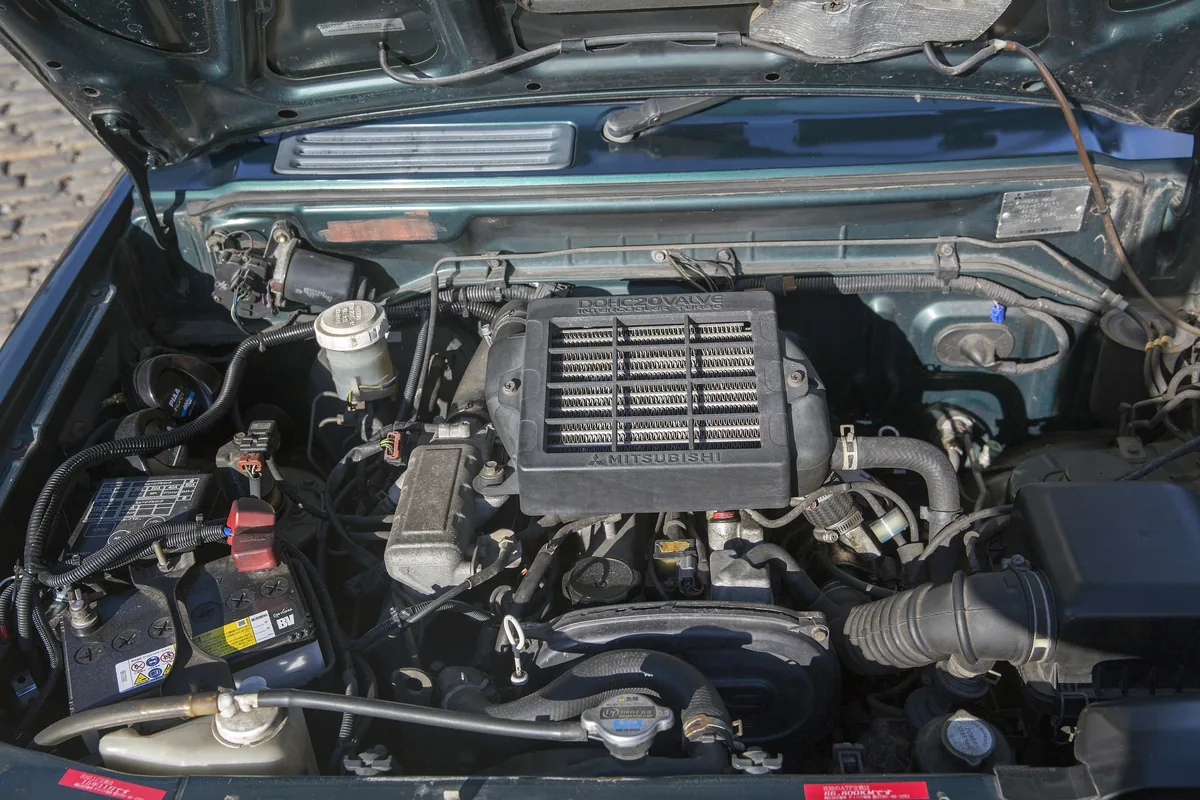
The engine was the headline. Mitsubishi offered a naturally aspirated version, but the one it highlighted was an intercooled 20-valve turbo, five valves per cylinder, producing 64 PS (47 kW) and 100 Nm. It drove through Easy Select 4WD, and although a two-wheel-drive version was available, buyers chose four-wheel drive by a margin of at least six to one.
Special editions followed quickly. The Skipper of May 1996 was aimed at town driving, and the Duke of December 1997 added rugged side cladding and an upright-bar grille, a deliberate nod to the Jeep CJ-3B that Mitsubishi licence-built for more than four decades.
Pajero Junior (1995–1998)
Some buyers found the Pajero too big and the Mini too small. For them, Mitsubishi launched the Pajero Junior in October 1995.
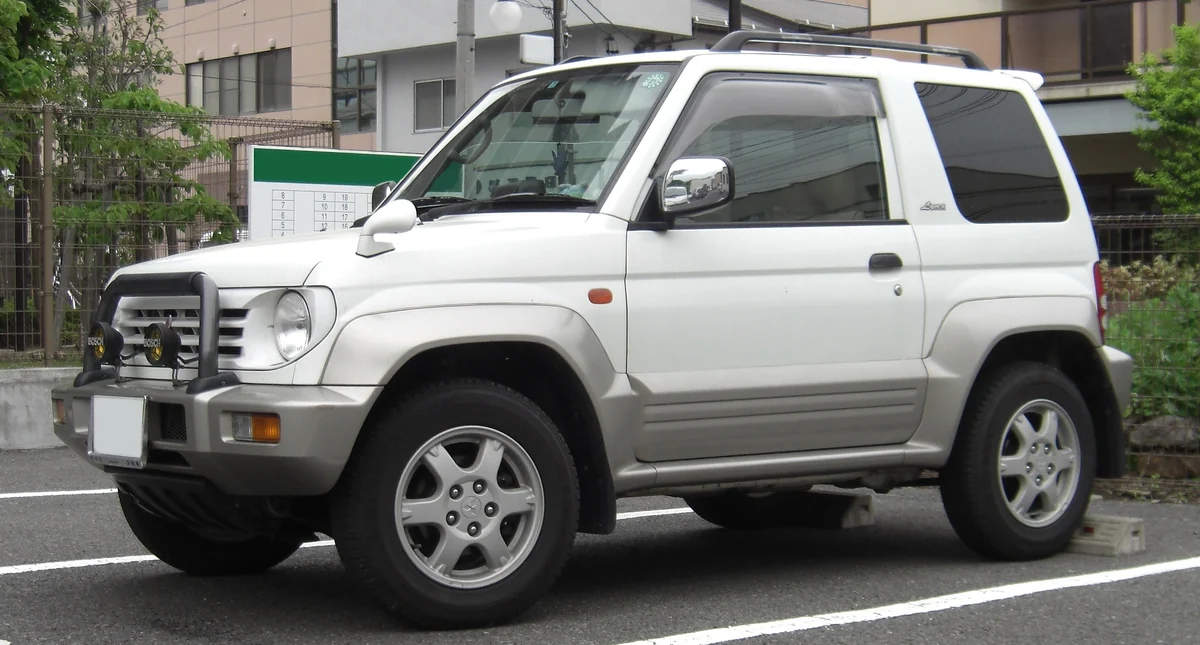
The Junior used a lengthened version of the Mini’s Minica-based platform, with wider wheel-arch flares and wider tyres that gave it a more purposeful stance. Its 1,094 cc engine, shared with the Mitsubishi Colt, produced 80 PS (59 kW), enough for a top speed of around 135 km/h. That put it in Japan’s compact-car tax class, above the Mini but well below the full-size Pajero. It kept Easy Select 4WD, with a low range for serious off-road use, and had double-wishbone front suspension.
The Junior was built for the Japanese market only. The later ZR-II, from January 1997, added a cluster of digital instruments with an altimeter, compass and outside-temperature gauge, a small-scale echo of the big Pajero’s famous Multi Meter.
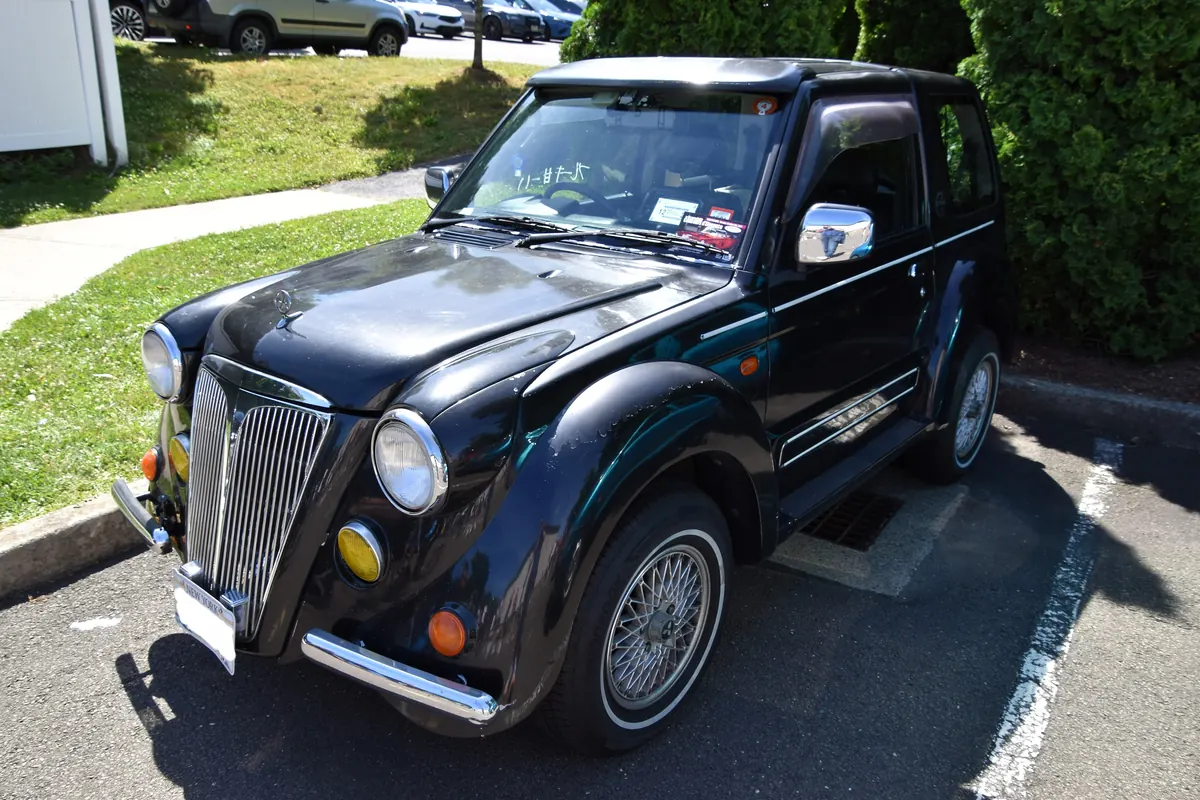
It also produced one of Mitsubishi’s odder limited editions. The retro-styled Flying Pug of 1997, which Mitsubishi’s sales literature likened to a London taxi, was so poorly received that only 139 were built. More significantly, many Juniors were exported unofficially: proof that there was demand for a small Pajero beyond Japan, and a lesson Mitsubishi applied to the Junior’s replacement.
Pajero iO (1998–2007)
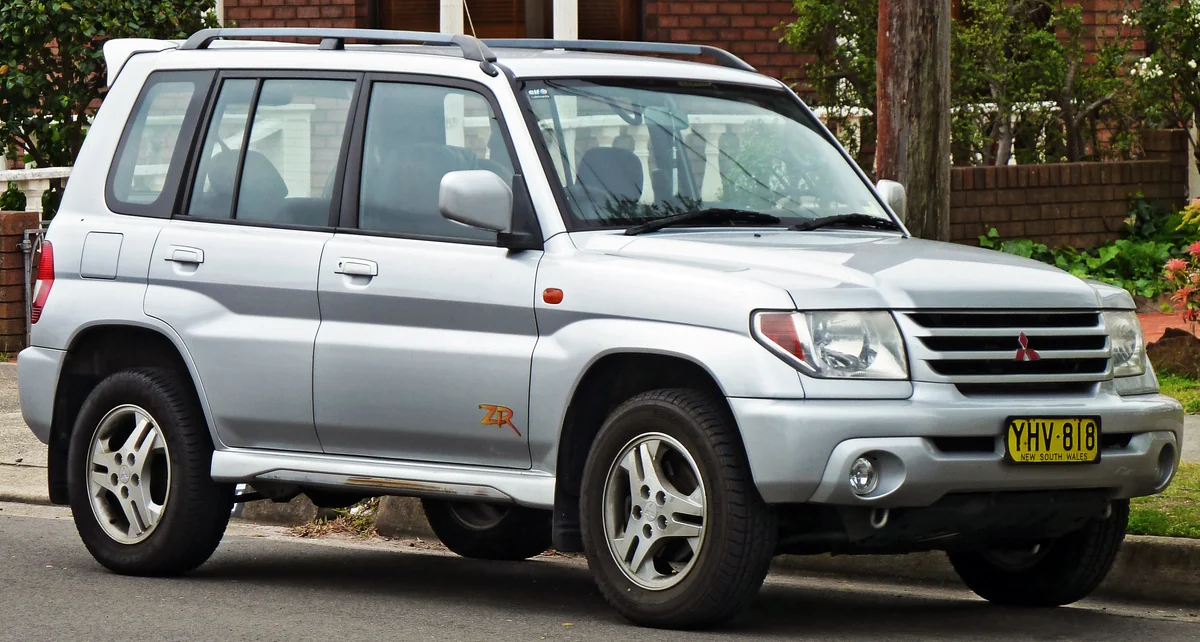
The Junior’s replacement took the small Pajero in a new direction. The Pajero iO arrived as a three-door in June 1998 and a five-door that August, and it was designed to leave the kei-car roots behind and take larger engines for international markets.
It used a 1.8-litre GDI direct-injection petrol engine and, crucially, Super Select 4WD-i, the first small Pajero with a version of the big Pajero’s signature four-wheel-drive system, explained in our Super Select 4WD guide. Mitsubishi says the iO was designed in collaboration with Pininfarina, and the name reflects that Italian connection: io is Italian for I, which Mitsubishi intended to suggest a Pajero that was easy to get to know and truly one’s own.
Pajero Pinin: the European iO
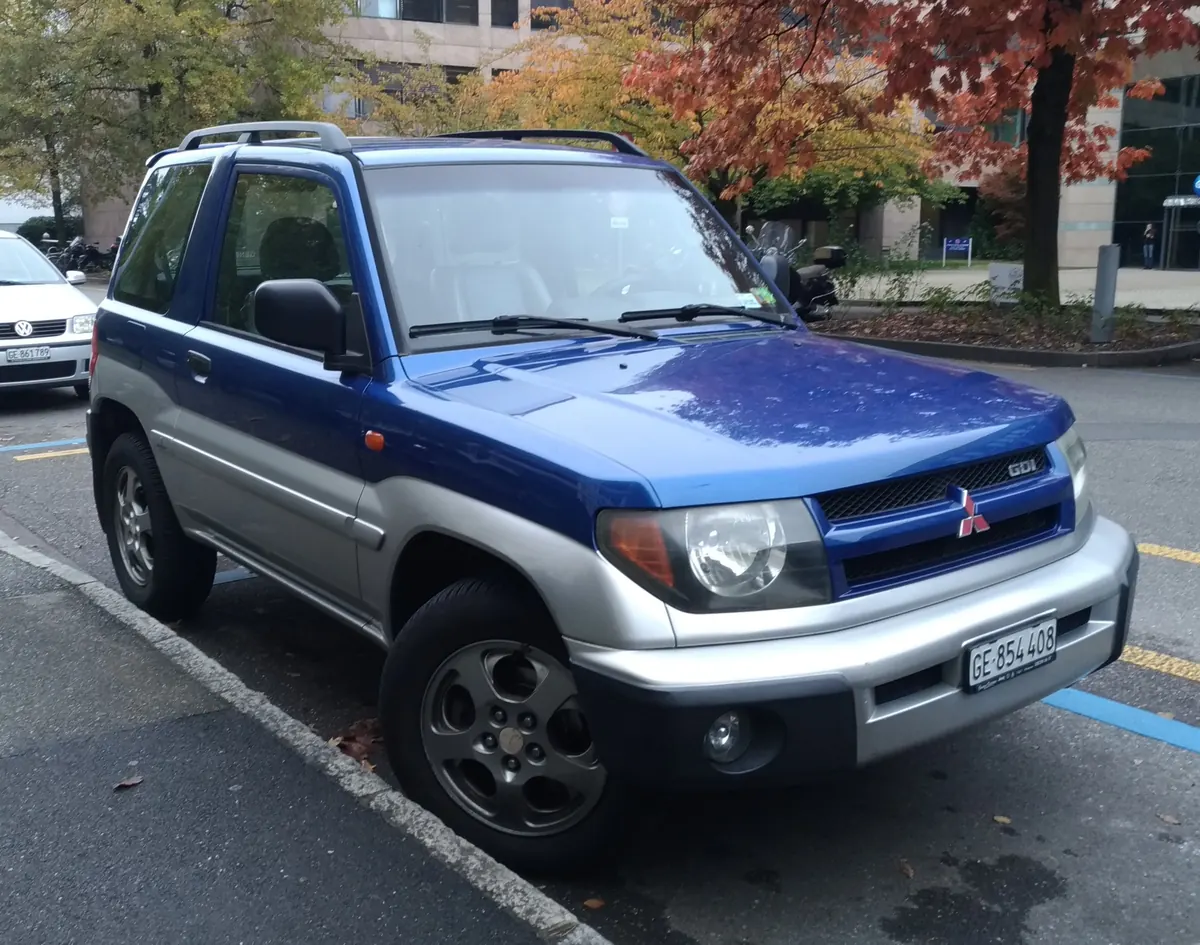
In Europe the iO wore a different name. Pininfarina built the European versions at its factory near Turin, and they were sold as the Pajero Pinin, the Shogun Pinin or simply the Pinin, a tribute to the coachbuilder. In some export markets the same car was the Montero iO; why one Mitsubishi can carry three names is explained in our guide to Pajero, Montero and Shogun.
The design proved remarkably durable. Brazil built it under licence as the Pajero TR4 from 2002 until 2015, nine years after the full-size third-generation Pajero ended, and in July 2007 the TR4 became Mitsubishi’s first four-wheel-drive flexible-fuel vehicle, able to run on petrol, ethanol or a mix of the two. A version was also built in China by Changfeng.
The second-generation Pajero Mini (1998–2012)
The Mini outlived all of its siblings. When Japan’s kei-car regulations changed in October 1998, Mitsubishi launched a second-generation Pajero Mini that was wider and longer to match the new limits, with a longer wheelbase and Mitsubishi’s RISE safety body for better protection.
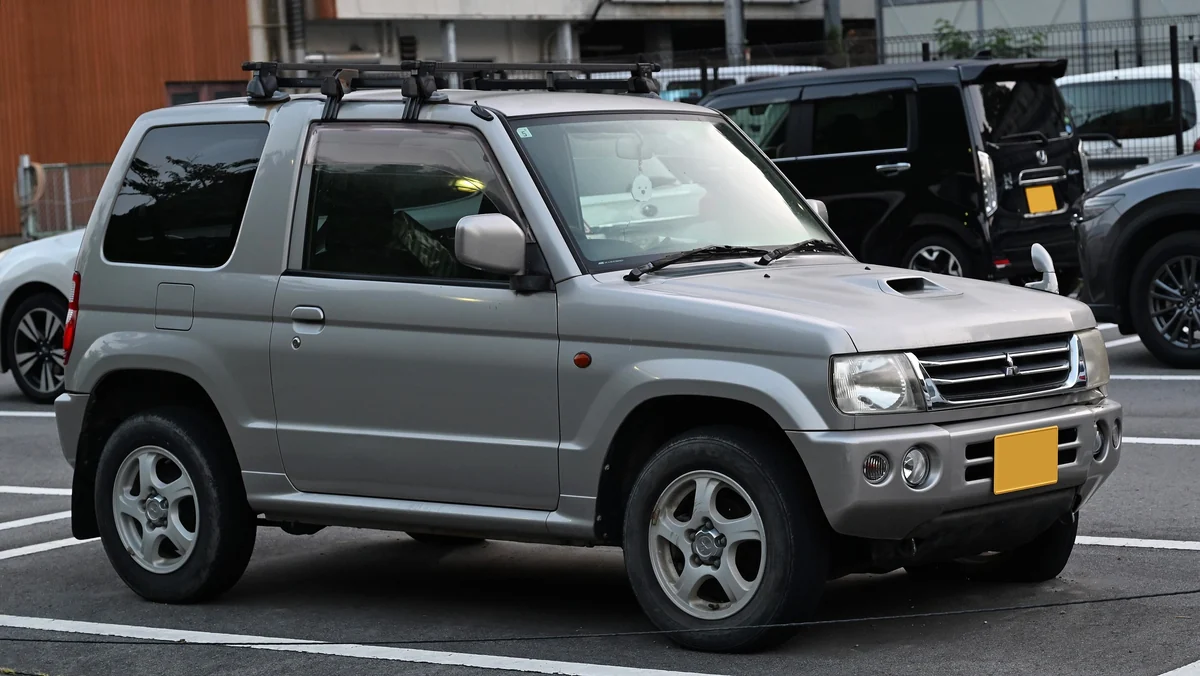
It also gained a more fuel-efficient engine: a lean-burn version of the 659 cc four-cylinder using Mitsubishi’s Vertical Vortex system, which cut emissions and fuel consumption by about ten percent despite the bigger, heavier body.
The second-generation Mini kept evolving. A Lynx model with four round headlights arrived in November 2000, a facelift in September 2003 brought a redesigned front, and a September 2008 update restyled the nose to resemble the full-size Pajero. From 2008 it was also sold as the Nissan Kix. Production ended in June 2012, nearly eighteen years after the first Mini.
The small Pajeros compared
| Model | Years | Class | Engine | 4WD system | Notable for |
|---|---|---|---|---|---|
| Pajero Mini (1st gen) | 1994–1998 | Kei car | 659 cc, incl. 20-valve turbo | Easy Select 4WD | The first kei-class Pajero |
| Pajero Junior | 1995–1998 | Compact | 1,094 cc, 80 PS | Easy Select 4WD | Wider body; Japan only |
| Pajero iO / Pinin | 1998–2007 | Compact | 1.8-litre GDI | Super Select 4WD-i | Designed with Pininfarina |
| Pajero Mini (2nd gen) | 1998–2012 | Kei car | 659 cc, incl. lean-burn | Easy Select 4WD | RISE body; longer wheelbase |
Frequently asked questions
What is the difference between the Pajero Mini and the Pajero Junior?
The Pajero Mini is a kei car with a 659 cc engine, built to fit Japan’s lowest vehicle tax class. The Pajero Junior, launched in 1995, is a larger version on a lengthened platform, with wider wheel arches and a 1,094 cc engine, which placed it in the compact-car class above the Mini.
Is the Pajero Pinin the same as the Pajero iO?
Yes. The Pajero Pinin is the European version of the Pajero iO, built by Pininfarina at its factory near Turin and named in its honour. The same car was also sold as the Shogun Pinin and, in some export markets, as the Montero iO.
Did the small Pajeros have Super Select 4WD?
Only the Pajero iO and Pinin did, with a version called Super Select 4WD-i. The Pajero Mini and Pajero Junior used Mitsubishi’s simpler Easy Select 4WD.
When did the Pajero Mini stop production?
Production of the Pajero Mini ended in June 2012, after two generations and nearly eighteen years.
Why is it called the Pajero iO?
Io is Italian for I. Mitsubishi chose the name to suggest a Pajero that was easy to get to know, easy to drive and truly one’s own, and it reflects the car’s Italian design connection with Pininfarina.
Image credits
- Header image: Pajero Mini VR-II Turbo 4×4. Photo: Charles from Port Chester, New York, CC BY 2.0, via Wikimedia Commons (cropped, with the driver’s face and number plates blurred).
- The 659 cc 20-valve turbo, with its intercooler mounted on top. Photo: Mr.choppers, CC BY-SA 3.0, via Wikimedia Commons (resized).
- The Pajero Junior, with its wider wheel-arch flares. Photo: TTTNIS, public domain, via Wikimedia Commons (resized).
- The retro-styled Flying Pug, only 139 were built. Photo: Charles from Port Chester, New York, CC BY 2.0, via Wikimedia Commons (resized).
- A Pajero iO ZR five-door. Photo: OSX, public domain, via Wikimedia Commons (resized).
- The Pajero Pinin, built for Europe by Pininfarina. Photo: Guillaume Vachey from Chalon sur Saone, France, CC0, via Wikimedia Commons (resized).
- A second-generation Pajero Mini from 2003–2005. Photo: TTTNIS, CC0, via Wikimedia Commons (resized).
Sources
- Mitsubishi Motors: Pajero History, the official model timeline.
- Wikipedia: Mitsubishi Pajero Mini
- Wikipedia: Mitsubishi Pajero Junior
- Wikipedia: Mitsubishi Pajero iO
- Wikipedia: Mitsubishi 4A3 engine
With thanks to Wilson in Australia, who pointed us to Mitsubishi’s official Pajero history timeline that underpins this guide. Spot something wrong? Tell us. We check and credit every correction.